Showing posts with label web/tech. Show all posts

1.05.2014

Four Progressions That Will Shape Internet + Technology Culture in 2014

As 2014 gets under way and we begin packing for the annual Consumer Electronics Show, its time to think about the advancements in internet and technology that could impact the way we all consume content and interact with each other. While we’re excited to see the latest in wearable technology, break-through high resolution TVs and connected electronics, the real game changers may not be device-specific at all. Instead, we’ll be thinking about the more subtle forces that could impact the future of marketing. Here are four progressions we see shaping internet + technology culture in 2014:

1. Public vs. Private Interaction 

In its early days, popular mobile messaging app Snapchat was heralded as a way for teens to send racy photos outside of the watchful eye of parents. But, as the audience grows in to the tens of millions, Snapchat is being recognized for what it is— the necessary outgrowth of years of “public” being the dominant value on the social internet. Sure, Snapchat’s photo-first messaging strategy is quick and fun to use, but its the freedom of impermanence that really drives the service in a way that can only be such a relief after understanding the exhaustion of the opposite.

It’s become clear that the drive towards openness is a symptom of a persistent Facebook-guided social media culture that has its limits and its repercussions. For many, it’s become tiresome thinking through the necessary polish and potential ramifications of sharing each piece of life content. Snapchat’s disappearing messages offer a way out — a way to engage with friends and family without thinking it through very hard, like you might in person. If that’s something we’re all yearning to return to, then Snapchat is just the beginning of a new wave of platforms and products that offers an alternative to the public eye.

2. In-depth vs. Snackable Content

In a year where Buzzfeed more than tripled its size, it seemed as if every publisher was rushing to emulate the magic formula by turning every article into lists, slideshows, animated gifs and Upworthy-esque headlines. The result is a web culture that in some ways feels like its one giant tabloid magazine for the attention-challenged generation— big, bold, suggestive headlines paired with flashy imagery in place of real depth or context. The snackable content format fits perfectly with the rapid-fire news stream that Twitter and Facebook has established. But like the gif-column, the news feed is a ride consumers may be starting to feel differently about.

 Just when it seemed blogging had been made extinct by 140 characters, new publishing platform Medium was conceived by the very same founder to provide a construct for people who want to write without distraction. Even more drastically, in December we saw the launch of The Information, a $400 / year online technology publication that promises just a few articles, on topics that deserve depth and dialogue. It may be time to start thinking differently about the content we create for consumers.

3. Open vs. Closed Infrastructure

The feature wars between Apple and Google, Facebook and Twitter, Instagram and Snapchat (etc.) have been well covered. But while everyone is focused on the land grab over a billion users messaging + photo + friend platform of choice, the bigger struggle developing may be over the destruction of the very fabric of the internet. The early days of social media were defined by openness— structures such as RSS feeds, open APIs and chat protocols. This early web infrastructure helped services grow and content spread in a collaborative, user-centric way that benefited all.

But in 2013 Google substituted its open Google Chat platform for its new proprietary Google+ Hangouts to compete with Apple iMessage, an equally closed messaging platform. Google also closed the RSS-powered Google Reader in hopes of making the silo’d Google+ the proprietary social news platform of choice instead of Facebook. Twitter notoriously reigned in its once public API to control its customer more tightly. The question is, will users be comfortable with these decisions as long as they are continually given new features, or will embracing the open internet begin to serve as a stand-out differentiator?

4. A La Carte vs. Bundled Video

Every time a cable network and broadcast company battled over carriage fees the cry for a la carte television becomes louder. The truth is a la carte is here, it’s just arriving through the back door of connected TVs and streaming video providers. In the last year, the arms race between Hulu, Amazon and Netflix has resulted in numerous water-cooler worthy original shows being created outside of the traditional broadcast model. The future is being defined by these new "channels", libraries of archive + original content a consumers wants to pay for at ~$8 a pop.

Unfortunately each library of content is silo’d in independent application gardens. Connected video systems like Apple TV require viewers to jump in and out of each ecosystem instead of easily navigating all of a user’s subscribed content in one menu, and may not even support each 3rd party “channel” as a competitive practice. We are in the golden age of television content, but managing your television has never been more difficult. This must be solved now, because a la carte will really be tested if the traditional networks and premium video providers like HBO start to disaggregate from the cable bundle as well.

Reference Links:
* This blog post was cross-published on the SS+K Blog

10.31.2013

Why Auto-Expanded Images + Vines on Twitter is Bad News


This week Twitter rolled out a major change to the tweet stream:  auto-expanded photos and vines in users main feeds.  Now instead of having to click to expand the Twitter card to view some rich media content, a 437x218 px thumbnail will be clearly visible directly below the respective linking tweet.  The tweet stream change rolled out across web, iPhone and Android all at once.

While at first this might not seem like a big deal, auto-expanded content could have an immediately negative effect on user behavior:
  1. Auto-expanded images break the democracy of content in your tweet stream.
    Instead of scanning all content equally, users' eyes won't be able to avoid skipping to the next image. And instead of engaging with the most interesting content in their stream, users will be drawn to the most visually stimulating.  With Twitter prioritizing rich media over text, conversation and link sharing no longer has equal standing.  In other words, Twitter is on its way to becoming another Facebook or Instagram, instead of the maintaining its status as the world's quickest and most robust news feed.

    The effects of images in the tweet stream may not be immediately evident when everyone is just getting adjusted, but consider Facebook.  While much has been made over the years of Twitter's 140 character limit, the optimal post on Facebook is actually 80 characters or less.  With Facebook's emphasis on photo + video in the news feed, written text (even a minimal 140 characters text) can't compete for attention.  Is this what Twitter wants for its future?

    The auto expanded images and videos are also accompanied by now immediately visible reply + retweet + favorite buttons.  The buttons makes the tweet stream feel much busier and slower to scan than ever before.  This is most notable on the desktop, where as many as twenty or more buttons in repeating rows of four now clutter the page above the fold.

  2. Brands were just given a back door to banner advertising on the homepage.
    Brands invest a great deal of time, energy and money in building communities on Twitter and communicating with their followers on a regular basis.  Planning for auto-expanded images + vines will become an immediate best practice for brands that want to maximize message exposure and engagement. Many brands also have more human and capital resources to invest in creating imagery to accompany every post, which contributes to the uneven playing field in the tweet stream.

    This reality will be even more apparent when brand tweets are paired with Twitter's paid promoted tweets platform.  Promoted tweets are published "above the fold" in the first few tweet placements.  Promoting a tweet with an auto-expanded image will allow brands to serve up a prominent visual banner ad on the homepage of Twitter for the first time ever.

    It's important to note that while brands will (and should) take advantage of the new Twitter format, high quality + high value content will still be critically important.  This is reinforced in two ways: users being able to easily unfollow brands that clutter their tweet stream with noise, and Twitter's auction model that factors a brand's quality score into the cost of advertising.

  3. Two links and minimal text per post becomes the norm.  
    Since including images in posts will be required to attract viewers, images will now be included in posts even when the goal is to share a link to an article.  This is immediately becoming the standard for publishers, who are pairing image links with article links to draw attention to their articles.  Because Twitter requires 22 characters per link to wrap the link in their URL shortener, two links eats up 45 characters (including a space in-between) before any copy is even written.

    It's worth noting, as well, that the new auto-expanded images appears to break article preview Twitter cards.  So when publishers pair images with their article links to maximize attention in the tweet stream, they're prioritizing the new form of banner ad over the valuable content + context they were providing to their readers upfront, before the click.


  4. Twitter images + Vine videos get preferential treatment. 
    Ever since Instagram pulled support for Twitter cards, images that were uploaded directly to Twitter have been more visible on the platform than photos shared from their competitor.  However, while the Twitter cards imbalance was Instagram's choice, the new auto-expanded images feature now gives Twitter's own image format a distinct advantage over any other image hosting service.

    Now users can expect to see plenty of Instagram photos (and images created using other tools) downloaded and re-uploaded natively directly to Twitter's image platform.  Popular API hacking tool IFTTT already has a recipe for automating the process of porting a photo from Instagram over to Twitter images.  This will create fragmentation in engagement around the same content, duplicated across platforms.

    This home court advantage will likely help boost Vine's success, as well, which is critical as Instagram begins to roll out its own advertising format.  Branded video on Instagram, with its :15 second time limit, is expected to be incredibly popular with advertisers looking to bring video spots to the 150 million strong Instagram audience.  Auto-expanded vines paired with paid promoted tweets will be a powerful tool for Twitter to combat Instagram's new offering.
With Twitter's IPO just around the corner, auto-expanded Twitter images + vines may just be one of many big changes coming to the platform.  For the health of the platform and its long term potential, Twitter must think through the impact all of its design decisions will have on user behavior.  It also needs to evaluate clearly which values Twitter wants its platform to stand for.  Choices like auto-expanded rich media may seem small at first, but they could do more to disrupt the democracy + dialogue the platform has been known for than any other changes Twitter has made to date.

2.11.2013

Trading in my iPhone 4S for a Google Nexus 4


Ever since I fell in love with the Google Nexus 7, I've been thinking about trading in an iPhone for an Android phone.  As I mentioned before, I think innovation in the mobile Operating System space is largely coming from Google (and even Microsoft) right now, and in comparison Apple's iOS is starting to feel stale.  The release of Android 4.1 Jellybean this summer was a turning point for Android, but there wasn't a phone worth buying yet until Google released the Nexus 4, a flagship phone in the same lineage of Nexus 7 that would always feature the latest version of Android.  As lucky would have it, I won a new Nexus 4 at a Google event, so this week I decided to take the plunge. 

I popped the sim card out of my iPhone and transitioned full time to an Android phone.

I'm going to spend a lot more time with the phone before I give an official review, but until then it's worth sharing some my initial reactions for anyone about to make a similar phone change cold turkey.  The phone itself is beautiful.  It's slim and light, but with a big beautiful screen.  Multi-tasking and cross-app integration is pretty fantastic (as It's always been on Android).  Voice recognition and other typing alternatives like native swype-style keyboards make information input a breeze.  The operating system is much more informative and actionable-- from better app notifications, to better data about your power usage.  And I have really high hopes for Google Now.

But there's also a lot of surprises.  Though the phone is very fast, the touch response feels a bit slower, akin to how Windows trackpads often feel compared to Apple.  And even though the operating system itself is fantastic, many applications aren't matching it in quality.  It seems many companies delay in rolling out their best features to Android, so applications I love on iPhone are only subpar on Android (for example, Evernote Hello doesn't have business card scanning functionality yet, and Nike+ doesn't have friend leaderboards or Path integration yet-- both popular features on their iOS equivalent).  And some great apps are still missing all together.

Also, Android's old selling point-- the most powerful versions of Google own applications-- isn't even true anymore.  The latest versions of Google Maps, Gmail and Google+ on iPhone are pretty killer, even better, I think, than what's on Android right now.  I think this is because on iPhone Google has a the highly evolved standard gestures of iOS, a refined standard that doesn't yet exist on Android (things like pull to refresh, left-swype menus and click-to-top headers).

So it will be an interesting ride.  I can already see a ton of pluses and minuses of both iOS and its standard hardware build (the weight and size is definitively easier to hold, but harder to read on) and the operating system (a more open OS leads to better integration but less polished functions).  I'm sure I'll learn a lot more as I spend an extended period with the phone.  And then come July, when the next iPhone comes out, I'll be ready to make an informed decision on what platform I'm going to commit to my next two years.  In the mean time, let me know if you have any Android suggestions or questions.

2.08.2013

Our Vineviewer Vine Search Engine Gets Some Love


We launched our labor of love VineViewer (a Vine video search engine) to the public one week ago now.  It's been an exciting seven days, so I wanted to provide an update on our web app.

Since roll-out, our development partner Firefall Pro has been killing it with feature updates and stability optimizations.  Now each Vine video has its own "card" which includes a link to the video post's original Vine post page as well as the shared Twitter post page.  You can search for multiple keywords at once, and search results now have unlimited scrolling.  Videos fail much less often, but when they do, we serve a nice error graphic instead of a 404 page.  There's a new "about" message that appears when you roll over the corner plus (+) graphic.  And the design is a lot cleaner overall.

We've gotten some pretty awesome coverage in the press:

And most of all, people seem to really enjoy using it.  Over 2,600 people have used the app so far, to search for everything from video game clips to peeks at the winter storm Nemo.  And the average visit duration is climbing to now over 3 minutes per visit (amazing, considering Vines are 6 seconds).

I hope VineViewer grows as a part of the Vine community.  We'll be thinking about ways to make it more useful.  In the meantime, continue to share it, and let us know what you think.

2.01.2013

We Built a Vine Search Engine


Last week Twitter launched a new video product called Vine, which enables users to quickly & easily record and share 6 second videos. Vine's big innovation is its way of enabling people to stitch a video together without having to use any editing tools, the result of which is a drastically lowered barrier to making an interesting looping clip. I'm loving Vine because vine videos feel really raw and intimate, characteristics that are unfortunately sparse these days now that just about every photo is cropped to a square, filtered and bordered.

But as much fun as it is to watch Vine videos, there's unfortunately no way to easily search for vines of topics of interest.  Enter VineViewer:
VineViewer is a fun utility developed (rapidly) by SS+K and Firefall Pro designed to allow people to search the growing library of vines based on their tags. We were really excited by the launch of Vine. Like everyone else in our business, we immediately began thinking of different ways we might bring vines in on our client work. In doing so, we lamented that there was no simple way to search for vines of a specific topic, like love for Valentines Day. 
VineCreeper is in in constant beta, and may evolve as we come up with more ideas for Vine. We hope people enjoy, and use at their own discretion.
We concepted and created VineViewer in just a couple of days, to fill a need and interest we had.  It's certainly rough around the edges, and there are some more features we'd like to implement (like a widescreen view and endless scrolling), but we wanted to launch it immediately for all Vine lovers to enjoy.  Learning about new social tools is all about using and prototyping, not polish.

So search for cats, puppies, babies and NYC to your hearts content.  Let me know what you think, and share it with your friends.

1.23.2013

Blogging is set to have a new golden age

The welcome screen of Medium.com (created by Biz Stone & Ev Williams of Blogger + Twitter fame)

Today Quora announced a new blog functionality.  It's not surprisingly getting a lot of attention because, on the surface, it appears to be a pivot for the company.  But in reality it feels like a natural extension of Quora's platform, in support of Quora's core mission: 
Quora's mission is to share and grow the world's knowledge
And while interesting, smart question asking has unearthed some even more amazing knowledge, without the right question a lot of great knowledge won't be published. So Quora's blogging product enables everyone with something great to say about a topic to contribute to it through a blog post.  That's Quora's innovation on blogging, by the way -- adding the ability to post original insight to a topic, without having to worry about building a following.

But Quora's new blog product is just another developing in an even more exciting trend: a new golden age of blogging.

After years of stagnation in the blogging space, the last few months have seen a flurry of blogging innovation.  Svbtle, Medium, Branch, and Quora have all created new publishing platforms that embrace smart, intelligent writing in unique ways.  They all embrace design as a way of enhancing the writing and reading experience.  And all of these platforms are helping to fight back against the trend of character counts, meme machines and animated gifs.

Branch, in particular, has me really excited because of how it's making social dialogue interesting again (more on this from me soon).

So if you've forgotten what it's like to write longer than 140 characters, or you're tired of just seeing auto-animated images, and you want to dive into some really interesting, thought-provoking content, start exploring one or two of these new platforms that are helping reignite a new golden age of blogging.  And share with me what you've found.

1.21.2013

My Social Media Footprint, January 2013


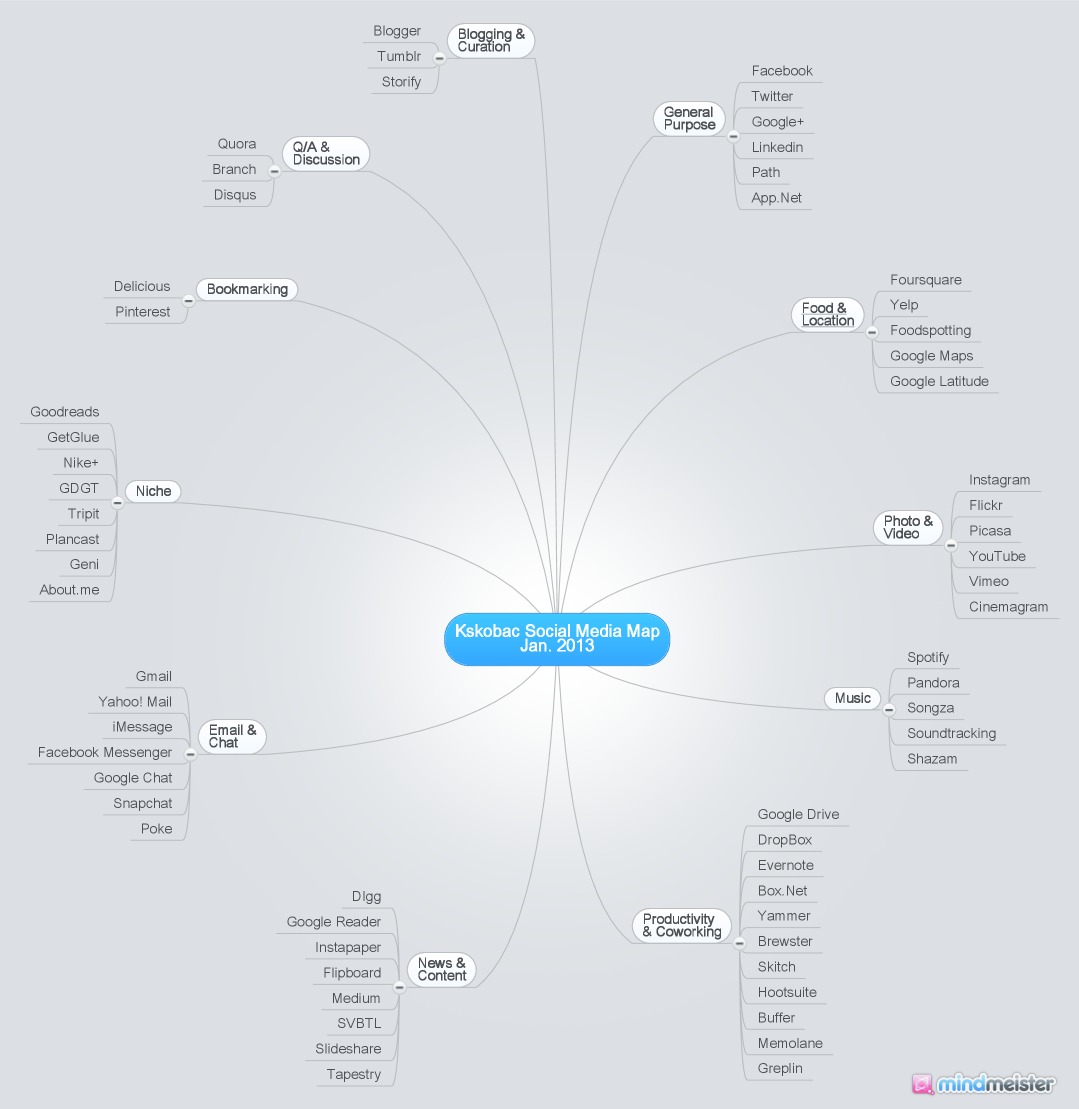
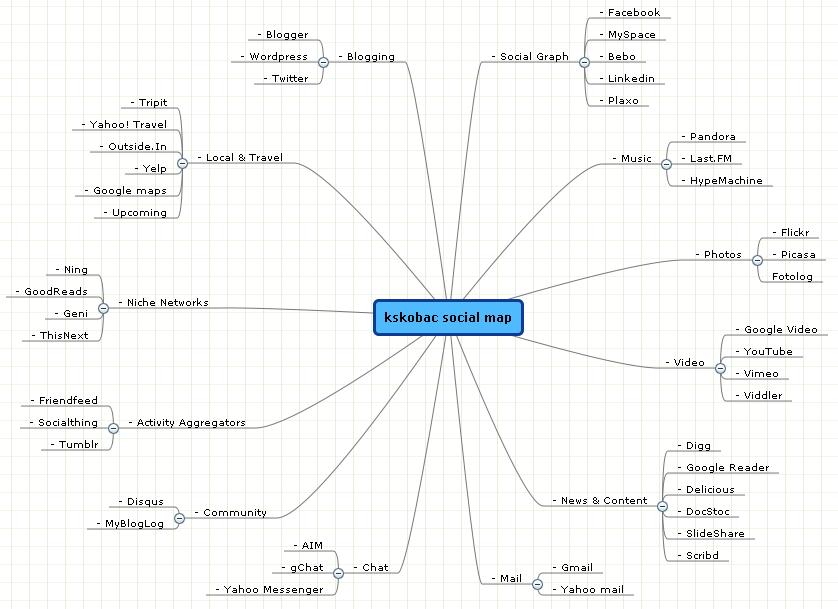
At the beginning of the year, I like to take stock of the websites, apps and technologies that I'm using on a regular basis.  This time I returned to an exercise I performed four and a half years ago when I drafted a map (see below) of my social media presence.  The social web has grown exponentially since 2008, so obviously there are more properties than ever on my map.  But what's more interesting is some of the trends that are illustrated.  

For starters, websites, apps and tech have all merged so much so that doing different lists seems a bit silly.  For this exercise, I used a loose definition of listing websites & apps that revolve around social interaction, be it creation, communication, management or sharing.

Also, many sites have changed classifications since 2008.  For example, my old graph has Tumblr listed as an aggregator, but since then Tumblr has switched from a pull-type service to a creation platform.  In fact, aggregators as a whole have basically gone away.

And social productivity was certainly a thing in 2008, but it was an outlier, not a tentpole category as it is now.  That feels like a reflection of the evolution of corporate IT, which has largely embraced things like Google Apps, DropBox and Evernote.

It's crazy to think how many social properties I've enjoyed that weren't even around four years ago, and amazingly are already obsolete (things like Posterous).  And certain categories are starting to be disrupted again, though they were relatively stagnant all this time.  Blogging is one of them.

I look forward to doing this exercise many times over in the years to come.  It's always interesting to sit back and take stock of how the web is evolving.  For the sake of comparison, here is my map from 2008.


1.15.2013

7 Discoveries and Observations from the CES 2013 Conference Floor


1. No matter how good you think your TV is now, it can always get better.
This year television manufacturers showed off new Ultra High Def (UHD) televisions that have 4K resolution, or about four times the resolution of today's high definition screens.  These big and beautiful TV's show virtually no pixelation when displaying UHD content (though upscaling non-UHD content may be less compelling).  Also present were new curved televisions that enable viewers to have a more balanced viewing experience (each inch of the screen is equidistant from the viewer), and an impressive dual-view 3D TV by Samsung that enables two people to watch different high definition 3D broadcasts in full screen at the same time from the same television.

2. It's more fun to use human interfaces and have physical interaction.
While TV's, phones, computers and cameras steal the headlines at CES, smaller companies tucked away in the corners innovating in ways you can't imagine are much more fun.  And many of these companies are helping us to interact with the world a bit more by building physical interaction into technology.  One particular cool gadget is Sphero, a hackable robot ball that you can control via your iPhone, around a physical track.  Sphero can also trigger augmented reality experiences, and be used itself to control computer programs through physical manipulation.  Also peek at Sifteo cubes, small computer cubes that pass information between each other, enabling all sorts of interactive puzzles and games.

3. Health technology and the quantified self are at a tipping point.
All sorts of companies are making health-tracking devices, from health start-up fitbit, to Nike Fuel to Jawbone Up, that track anything from how many steps we've taken to how well we're sleeping.  But wearable bracelets won't be the only way we measure, share and analyze our health data.  Withings has a connected scale that measures your weight, BMI, heart rate and even the air quality around you.  As more companies enter the health tracking fray product innovation will collide (Withings has a wearable monitor now, and Fit Bit has a connected scale).  The bigger question will be how well these companies can guide our real life health improvements based on all of the data we're collecting.  

4. Every device will be connected soon (so plan for bigger data plans).
Just about everyone seemed to enjoy playing with Samsung's new Galaxy Camera, an internet connected digital camera with an Android operating system built in.  Now you can install your favorite mobile apps like Instagram right to your camera to filter and share photos as soon as you take them.  Samsung also showed off a connected refrigerator that includes popular applications like Evernote, so people can collect recipes from anywhere and browse or view them directly on the screen in their kitchen.  With the internet of things growing so quickly, ubiquitous connectivity and shared internet plans will need to improve along with it.

5. Kickstarter is one of the most exciting names in consumer technology.
One of the most anticipated announcements at CES was from Pebble, the ambitious smart watch that was funded on Kickstarter.  The Pebble raised a record-setting $10 million dollars to build their product back in April, but didn't announce their shipping date until CES.  If Pebble lives up to its promise once in the hands of consumers, the next CES might be much more focused on the independent technology innovators that are arising in part to innovative funding models like Kickstarter, rather than the big behemoth technology companies that lead the market today.  In fact, many of those big market leading companies seem to be pulling out of CES all together.

6. The big four internet companies are confusingly second fiddle at CES.
Google, Apple, Amazon and Facebook, known as the big four internet companies, have become successful through their merging of content, services and technology in a user-friendly way.  Each, to different degrees, are defining what it means to be a connected product today, from user experience to content to ecosystem compatibility.  And while CES is full of other companies making devices for those platforms, the names defining the space need to stand up and illustrate their vision for the future.  There may have been hundreds of devices from different companies on the CES floor that included Android, but Google needs to lead the discussion of how all these devices will work together with Android at its core.

7.  Welcome to the new CES, it's not just a trade show.
The biggest story going into the week was actually how few product announcements would be taking place, with many technologies likes cameras and phones now saving their biggest own popular trade shows later int he year and big names like Microsoft having left altogether.  But a reported 150,000 people from all walks of life attended the convention this year, the largest audience in CES history.  More significant may have been the tens of thousands of brands, sales and marketing companies who spent the week in Las Vegas talking about the implications of the consumer electronics revolution and its implications on media and marketing, without ever stepping on the conference floor.  CES may be changing, but for new reasons its just as interesting and important none-the-less.

12.18.2012

The Magic of Google Now and Thinking Different

"To me the great irony is that Apple’s slogan was `Think Different,’ but today if you think different you’re looking at Android.” - Guy Kawasaki, former Apple Chief Evangelist

As anyone close to me knows, in 2009 I made a complete jump over to Apple products.  I traded in my home PC for a 13" Macbook Pro, my work ThinkPad laptop for a (now) 15" Retina Macbook, my Microsoft Zune and Google Android HTC G1 for an iPhone.  In every instance I was happier, inspired even by the differences.  My laptops were reliable for the first time ever - they didn't suffer from memory lag, battery drain, or buggy trackpads.  The G1, which was the first Android phone on the market, had been ground-breaking compared to my feature phone before it, but the iPhone put it to pasture with its sheer speed and app quality.  I became, like most people in the Apple camp, transfixed with Apple being the height of quality and innovation.

But in the last year, things have begun to change.  I spent a few months with a Windows Mobile phone enjoying the fresh take on a mobile OS, and in the last few months I've fallen in love with my favorite new gadget, the Google Nexus 7.  The Nexus, and more specifically the new version of Android, is a revelation.  Where all six of the previous Android devices I used before fell short, the Nexus shines.  Navigating the device is smooth and intuitive, with true cross-app integration and action-oriented notifications illustrating the faults of Apple's silo'd approach.   Widgets on the lock screen and "desktop" make carrying around the tablet more useful at a glance than the iPad.  Small touches like built-in "swype" typing make the tablet typing faster.

The biggest eye-opener of all is Google Now.  At a basic level, Google Now is Google's take on Siri, but in practice it makes Siri look like a child.  Google Now taps all of Google's intelligence and all of a user's personal information to actively help you throughout the day.  Pull it up in the morning and Google Now will tell you your favorite team's sports score from last night, today's expected weather, have directions to your next appointment and how long it will take.  Open it after a flight and Google Now will tell you how long it will take you to get to your hotel, some restaurants and sites nearby you'd want to try.  The information is actively pushed to you based on what you signal to Google you need, from recent searches, email receipts, location history and more.  It's smart, surprising and useful-- in short, magical.  It shows you what's possible by tapping geo-awareness, personal information and crowdsourced intelligence at scale.  It makes you forget about all of the privacy and personal information concerns, and maybe even wish you had more to give. 

Recently I was speaking with some team members who are incredibly experienced and often "in the know".  They had not heard of Google Now, were not familiar with it's capabilities.  They carry Macbook Airs, iPads and iPhones, and presumed, as most of us do, that the best of what's possible is happening on one of those devices.  But my re-awakening to the world outside Apple emphasizes why it's so critical to step outside your comfort zone and use different products once in a while.  Why you should stop by a Windows 8 Store to explore the new Surface and HTC 8x.  Why you need to try a Nexus 7 before you commit to buying the iPad mini.  If you don't, you won't realize the possibilities that are out there, the break-throughs that are happening, the innovation that is being displayed outside of Apple's garden.  You won't realize that iOS is starting to feel really stale, sitting back passively and waiting for you to ask it a question or jump into a single app experience, while Google Now actively pushes you everything you need and more.  You won't "think different", the way Apple challenged us to.

11.12.2012

Why I Bought Tweetbot, and the Rising Cost of Apps


I just happily purchased the new Tweetbot for Mac client for $20, which is probably way more than anyone ever imagined spending on such a specific thing as a Twitter client.  But it was completely worth it to me for a few of reasons:
  • Tweetbot's developers Tapbots do incredible work for the iPhone, iPad and iOS, and I want them to keep doing it.  So I need to help them make enough money to stay in business
  • Tweetbot is not only the best desktop and mobile Twitter client available, it's probably the last great Twitter client that will ever be built because of Twitter's new horrendous API rules
  • I want to help push app paid app economy, which is suffering at the hands of downward price app store price pressure and unreasonable expectations, as proven by the Sparrow dilema
The reality is, as we move in the direction of $0.99 everything, or worse yet propagate the expectation that everything can be gotten for free, we force apps to be gimmicky, ad-laden, or catered to the lowest common denominator in the pursuit of hundreds of millions of users.  As app developer David Barnard puts it:
Computer users used to spend hundreds of dollars for great software and pay again every couple years for upgrades. But over the past couple decades people have grown accustomed to getting more and more value from software while paying less and less for it. The web has played a huge part in that, but the trend was accelerated by the App Store and Apple’s management of it.
Extremely high quality apps that appeal to a niche crowd have a harder and harder time surviving.  That will be the case until we return to being willing to reward high quality applications with adequate payment.  Unless we're happy in a world where Google and other behemoths acquire everything interesting under the sun and decide each fate as it ladders up to their larger objectives.

So I'm following up my purchase of Tweetbot by purchasing Clear, another innovative app that I want to see pursue it's goal.  And I hope others follow suit, because I'd like these products to have a chance at sticking around, and not just until Google buys them and shuts them down.

10.31.2012

NYC Taps Twitter to Power Through Sandy's Aftermath

In the wake of the craziness that was Hurricane Sandy, I'm really impressed with how Mayor Bloomberg has used Twitter to keep New Yorkers as up to date as possible on what's going with the city.

I've been following real-time updates all week via @NYCMayorsOffice, @MikeBloomberg, @MTAInsider and @NYCGov accounts.

Then this morning I noticed promoted tweets (which Twitter is providing for free to emergency services accounts) appearing in my Twitter stream highlighting the most recent city update tweets from the @NYCMayorsOffice.

And just now we were all invited to watch a live stream of Mayor Bloomberg's upcoming press conference via an embedded inline YouTube feed (see the screenshot above or the embedded tweet below).

Thanks Mayor Bloomberg, and your whole staff, for doing what you can to keep us informed!

8.17.2012

POV on Twitter's API Announcement


Below is a draft of a POV on Twitter's API changes that I wrote as part of my work for SS+K.  It's being published here post-dated as reference.

The big news in the tech industry this week was Twitter's long-expected announcement of changes to their API (the tools 3rd party applications use to plug-in to Twitter).  Twitter announced that the company would no longer support carte-blanch use of their API by 3rd parties.  Instead,Twitter is enforcing everything from design guidelines to build principles.  Their stated purpose is to focus any regular Twitter user engagement (think: the usual things consumers do on Twitter, e.g., read, reply, retweet messages) all happening on official Twitter 1st party applications.  Their demand (disguised as a request) is that 3rd parties focus on building applications that provide an inherently different functionality, especially enterprise-oriented capabilities, such as measurement and media integration.  

While Twitter is clearly within their rights to place rules on 3rd parties who want to integrate with their product, the move is being seen as incredibly controversial because Twitter's success as a platform was largely a result of the types of 3rd party developed innovations that Twitteris planning on forcing out or shutting down.  In fact, Twitter Search, Twitter for iPhone, Twitter for Android, Twitter eMail summaries and Twitterfor Chrome are all functionalities built by 3rd party companies and purchased by Twitter.  In many cases, theses applications were built to give users experience that they wanted or needed, but Twitter didn't have the bandwidth to provide.  In many ways, 3rd parties carried Twitterthrough the dark period where Twitter was often broken and unreliable.  By restricting 3rd parties, Twitter is not only turning its back on the community that helped build it, but also potentially stifling the type of future innovation that could take the platform to new heights.

Twitter's argument for these decisions is mainly two-fold:

  1. Consumers need to have a consistent experience and reliable expectations when engaging with tweets.  The company believesTwitter content needs to be uniformly designed and packaged with all of its functionality so users everywhere recognize the content asTwitter and know exactly how they can interact with it (i.e., always be able to reply or retweet).
  2. Twitter needs to be capable of earning enough revenue to support itself, and the way to do that is to make sure users are spending their regular tweeting and reading time on a standard Twitter platform that Twitter itself can monetize, through their standard promoted tweets, trends and search products.
Ultimately these changes complete Twitter's transition from communication company to media company.  Like Google with its move towards universal search and rich media snippets, Twitter is bringing more content inline into its feed through their new "Twitter Cards" format, trying to maximize the time-spent and eyeballs on its own domain.  It may not be the vision Twitter's original power users and developer community envisioned for the company, but it's clearly the direction it feels is necessary for its optimal future.  The outcome will be a more refined and uniform experience that helps Twitter grow its mainstream audience, but loses some of its advocates and puts it more directly in competition with news and entertainment media companies than ever before.

While much of the outcome of the new API rules remains to be seen, expect a few implications for brands as we head into 2013:

  • Custom brand products that pull in and display tweets, including Facebook tab applications or website plug-ins, will need to be updated to fit the new display guidelines.  This reduces the ability to customize the look and feel, but will likely increase user engagement.
  • Since Twitter Cards (inline content previews) will start to be featured abundantly across the Twitter ecosystem, brands will want to include links to supported 3rd party content in their tweets to maximize engagement potential.
  • Since the future of existing 3rd party reading clients is up in the air, companies like Flipboard will likely start to iterate in directions away from Twitter content.  Brands need to consider where they invest in media and partnership dollars if they are investing in any of these environments.
We will be watching the Twitter ecosystem + platform developments carefully, and provide further guidance on the implications, directions and opportunities as they become clear.  Please let us know if you have any questions.

4.16.2012

SS+K's Foursquare-powered Birthday


Today is the (the SS+K's 19th birthday (where I work), and coincidentally it's also Foursquare Day. Some background first: my co-workers and I happen to be somewhat obsessed with Foursquare. We have 18 different micro-locations in our office, and people are constantly battling for mayorship- so much so, that last year we created our own Mayorshup, a Risk-board of sorts for SS+K'ers to battle each other for supreme SS+K office mayor.

So a few weeks ago we had an idea for celebrating SS+K's 19th Birthday and Foursquare Day at once- we'd create the first ever Foursquare-powered birthday card. When someone checks in to any of our office Foursquare locations, they "sign" our card by adding their Foursquare profile picture to our emblem, and adding their username to our card. The card is of course viewable online on our site, and also is being displayed on a giant lcd screen in our cafe.

We've also opened an SS+K Foursquare Labs page to host the many Foursquare hacks + projects we've launched in the last year. This whole thing has been a pet project of mine, so I'm really excited for it to be live. Thanks to everyone (@alvvvvvin @brainpuppy @FirefallPro + more).

3.04.2012

#Kevs30th Birthday Social Media Style

In true geek fashion I established #Kevs30th for social media fun, and captured the whole thing on Storify

1.24.2012

Saying Goodbye To Things You Love

One of the challenges of being a web early adopter is the likelihood that a lot of services you fall in love with will ultimately disappear.  New start-ups are launching exciting digital products for us to fawn over every day, and many of us web obsessed rush to try them as soon as possible.  The ones we like we invest a ton of time in, way before there's any chance of knowing if anyone else will be interested enough to join along and help propel the start-up to become a viable company.

On a good day we become obsessed with the start-up, preach about it to everyone we know, and then take some credit for it's success as it builds towards greatness.  But often times the start-ups we love don't make it.  Not enough people end up seeing the value in the product and the product shuts down, or the company's ambitions of their own success get usurped by a high priced suitor that strips it down for parts.  Either way the outcome is the same: the product we love disappears from us.

This last week I've had to say goodbye to a number of products I've really enjoyed over the last few years, all for different reasons.  News aggregator Summify was acquired and neutered  by Twitter.  Online photo editor Picnik was shuttered by its owner Google.  And Plancast CEO Mark Hendrickson announced he will be giving up on the pursuit of his two year old social event sharing product after it failed to gain enough traction on the web.

While saying goodbye to Summify and Picnik is tough, both are in a popular space and have strong competitors that will serve as worthy replacements.  Plancast, however, is by far and away the best social event sharing site I've ever come across.  It's attractive, incredibly easy to use, and has powerful integration built in to other event platforms like Meetup, EventBrite and Facebook that helps make event sharing effortless.  Whereas the old stalwart event planning site Upcoming.com was painful to populate, Plancast is a pleasure to use and explore.  It's one of the products I can't really understand why enough people found compelling enough to use, and one that I'll really miss when it's gone.

The good news about being a web early adopter, though, is that for every start-up heartbreak there's a new start-up to take it's place.  I wake up every day now excited to play with Path, I'm testing out Buffer to power my social publishing, and I've just signed up for News.Me to replace the hole that Summify will be leaving in my day.  And I can't wait to preach to you about all of them.

1.04.2012

Excited About Quarterly Co, a Subscription Service for Wonderful Things

One of the new web services I'm super excited about heading into the new year is Quarterly Co, a "subscription service for wonderful things".  Basically you subscribe to a person of your choice, and that person sends you an actual package in the mail every quarter with an interesting object(s) of their choice.

Of course these aren't random people with nothing to lose; the curators that Quarterly has brought on board are all tastemakers of some sort that make finding interesting things the basis of their reputation.  People like Josh Rubin from Coolhunting, Tina Roth Eisenberg from Swissmiss Studio, or the famous Maria Popova of Brainpickings.  I've chosen Alexis Madrigal, tech writer at The Atlantic.

So every 3 months you can expect to get something interesting in the mail that reflects their taste, perspective and interest.  It's a brief moment in time to turn away from the rapid information stream on Twitter (partially populated by these same people) and enjoy a tangible thing hand selected by someone you admire.  It remains to be seen whether any of us feels the object we receive is worth the $25 per quarter, but I imagine the surprise gift and the ensuing conversation will leave me very content.

Let me know if you've subscribed to anyone in the comments below, and stay tuned in March for an update on what I get in the mail.

12.04.2011

Continuing Education

One of my goals for 2011 was to put more effort into continuing my education.  After graduating and transitioning to the work force it gets a lot harder to feel like you're learning and getting to grow mentally in directions beyond what your job dictates.  However, living in New York City, I am lucky that there are a lot of ways to take classes and attend lectures for relatively minimal money.  Here are 5 local ways I "get back in the classroom" (and one bonus on-line resource):

Ignite Sessions
Ignite is a unique event where you learn a little bit about a lot of things through a rapid-fire series of short lectures.  Speakers can apply to present on anything, and typically the collection of chosen lectures varies widely from technology, to the arts to society.  Each speaker is given 5 minutes to present a coordinated talk along with 20 slides that turn on their own every 15 seconds.  The structured nature of the event keeps the audience entertained whether the topic is NASA research, samurai swords, or anything else.  Events are usually around $10.  You can view all of the past Ignite NYC talks here: http://www.youtube.com/user/IgniteNYC#g/u

Creative Mornings
Creative Mornings are "a monthly breakfast lecture series for creative types".  Each monthly event is usually about :30 minute breakfast, :30 minute lecture and :30 minute Q+A discussion session.  Past speakers have been writers, entrepreneurs, venture capitalists and more.  They take place on Friday mornings from 8:30 a.m. to 10 a.m. and have been sponsored, so attendance is free (and sign-up fills up fast).  You can view all of the past Creative Mornings lectures here:

General Assembly
By day, General Assembly is a co-working space where teams of people can rent desk space and share collective office resources.   By night, General Assembly is a an educational campus that hosts classes to help teach new technology, business and marketing skills.  Classes usually cost around $25 per hour and are taught by employees from small start-up companies to Google employees.  This year I took classes on Gamification, API Programming and Website Wireframing.  Unfortunately, the classes have been a bit hit or miss because they're sometimes taught by smart people who aren't good teachers.  However, I'm optimistic and will continue to try more.

TEDxBrooklyn
TEDx is an offshoot of the popular global TED conference, though on a local level.  The organizers of TEDxBrooklyn put together an annual all-day event mixing talks from local business leaders and artists with curated videos of the global TED conference.  This year's event was held at Brooklyn Bowl, and the topic was "redefining better".  Highlights included motivational speaker Jullien Gordon, Etsy CEO Chad Dickerson, Gotham Greens founder Viraj Puri and several music & art performances.  The event cost $100 for the full day, including lunch.  The event wasn't perfect, but I expect that the quality will improve each year as the founders gain more experience.

140 Characters Conference
http://140conf.com 
140 is actually a series of conferences throughout the year that covers a number of topics.  This year I attended the tentpole #140conf ,  a 2-day event discussing how social media effects business and people, and #140edu , a 1-day event discussing how social media can improve education.  The first event was a series of short :10 - :15 minute presentations and panel discussions, and was very interesting in the same way that Ignite typically is.  The edu event was a more classic format, with fewer + longer presentations, and wasn't nearly as interesting.  I would make my decisions to attend future events based on the format and the costs- which varied from $1.40 to $140 per event (discounts to frequent attendees).

Next year, in addition to attending conferences and classes, I'm also committing to taking some online courses.  One site I'm really excited about is Codecademy.  The site is basically a collection of "gamified" courses on web programming.  Courses are broken down into small incremental assignments, and motivation is driven by badges and level completions.  Codecademy seems like an powerful, free, way to learn new subjects, one I'm very excited to spend more time with.  I'll update everyone soon on how it goes.

So what are the ways you learn?  And what are your other 2012 goals? 

9.14.2011

Facebook Fights Back At Google, Twitter and Tumblr With Four New Features


Facebook made 4 platform changes this week that aggressively compete with some of the most popular functionality on Twitter, Google+ and Tumblr:
Smart Friends Lists
Facebook will now start creating intelligent friend lists for users to help facilitate sharing and filtering based on likely interests + need states.  Facebook is starting everyone off with Work, School, Family and City lists, but the intelligence will start recommending people to you as you create your own custom lists as well.  This is a major attempt by Facebook to show that they can do lists better than Google, who launched Circles as the main attraction of Google+. 

Subscribe to a Person
Until now, Facebook relationships were always a mutual connection between two users.  However, users  now have the option to allow others to "subscribe" to them, without actually "friending" them.  This new asynchronous dynamic gives personalities the ability to broadcast public information to anyone who's interested while still preserving their personal relationships.  This means public figures no longer need to manage profiles AND pages for themselves (though pages are still the solution for brands and products that will build more robust content).  Allowing asynchronous relationships is a major departure from Facebook's policy to date, and is a direct attack on Twitter.

Facebook to Twitter sync
Though Facebook pages have had the option of syndicating their content out to Twitter for a while, soon users will also be able to link their Facebook accounts to their Twitter accounts.  Facebook is hoping that its users will have less reason to hop over to Twitter, while at the same time send more traffic from Twitter into Facebook.

View Page Post Shares
Starting today when you view a post on a Facebook page you will be able to see how many "shares" it has, in addition to 'likes' and 'comments'.  When you click the "shares" button you will see a list of people who shared that post to their own page, and any public comments on their re-post.  This isn't a major feature, but it makes sharing feel much more like Tumblr's popular "reblog" feature.
All of these changes will likely be appreciated by Facebook users, and will likely help stem much of the criticism Facebook's gotten as of late.  It will be interesting to see how Google, Twitter and Tumblr respond to Facebook's new functionality.

8.30.2011

An update on Google+ for Brands

Below is a draft of an updated POV on Google+ I've drafted for the perspective of brand marketing opportunities.  Thoughts, suggestions or critiques are welcome.

Now that Google+ is nearly two months old, I wanted to provide an update on how Google’s ambitious new social project is doing, what new features + functionality have been added to the product since launch, and how these new elements impact the outlook for brands. Despite entering a competitive landscape, Google+ has received intense attention from Google users, media and brands. In just a few shorts weeks over 25 million people have been estimated to have tried out the network. Google has met the enthusiasm with a barrage of developments that hint to the potential of Google+ moving forward.

A more powerful +1 button for publishers 
When initially launched, Google’s +1 button for publishers had an ambiguous purpose. Consumers clicking the button could potentially improve a site’s search ranking, but there was no direct connection to Google+. Now when users click the +1 button they will not only affect the page-rank of the site, but will also have the opportunity to share the web-page directly to their Google+ stream. Google+ users will also see which of their friends have clicked a +1 button right next to the button on sites. The behavior will be very similar to clicking the Facebook ‘like’ button, both in it’s on-site representation and by displaying a photo and descriptive text snippet in a user’s feed. This will give users much more reason to click +1 buttons on content around the web.

Considering both the SEO and social amplification power of the new +1 button, all brands and publishers should be preparing to include +1 buttons on their sites prominently. There are a few steps website managers need to take to maximize the benefit:
  • Update the +1 button code on their sites to display the in-line social graph info 
  • Include the proper HTML mark-up on your web-pages to specify which pictures and copy are auto-generated when users share to Google+ from the +1 button on your site
     
Extended reach through massive Gmail community
When Google+ launched many people were surprised to find that it had no connection to Gmail. Now, however, Google has taken the first steps towards integrating with the popular email client by integrating Google+ updates into the new Gmail people widget. When looking at an email in Gmail, your contacts most recent public Google+ post will be visible in the sidebar along with their other profile information. This extends the reach of Google+ status updates way beyond the Google+ user-base out to the millions of people who use Gmail daily, making Google+ content sharing much more attractive to brands.

A more social YouTube experience with Google+ Hangouts
From the beginning, Google+ users have been able to load YouTube videos inside Hangouts (group video chats). Additionally, now when watching a video on YouTube users are invited to launch the video inside a Google+ Hangout to share the viewing experience with up to 10 friends. Like the Gmail integration, this exposure on one of Google’s most popular properties will help boost awareness of Google+. This is also a potentially valuable Call-To-Action for brands to promote on their YouTube channels: not just to watch a brand spot, but to invite friends to watch, enjoy and discuss along with one another.

Increased time spent inside Google+ through games
Google+’s biggest advancement so far may be the launch of Google+ Games. The games platform is very similar to Facebook’s, focusing on casual social games like Bejeweled that challenge friends to beat each other’s high scores and more. Google noticeably kept games alerts from infiltrating the regular Google+ feed; rather it’s information streams are kept on a separate feed users see when playing games. While less integrated, games will still ensure that users spend more time inside Google+ and return to the network more often. They could also be a potential way for brands to offer engaging experiences to users, once the developer platform is opened to all.

But official brand accounts are still missing (for the most part)
The most notable development about Google+ so far, though, may be that Google still hasn’t made any announcements about how brands will exist on the network. Google has actually gone out of their way to remove brand pages that pop up, or work with brands to transition their pages to a representative employee. So far the only hint that brand pages are coming soon, besides Google’s continuous promise, has been the launch of the Ford Motor Company test account. Ford notes that the profile is an early test of Google+ business accounts, and is experimenting with a number of Google+ features like Hangouts. Despite the early access Ford doesn’t appear to have any special features or functionality on their page yet. However, many additions like Google Analytics and advertising integration are expected to come, and may already exist on the back-end. Google will presumably also look at adding other features like brand directories, enterprise level moderation tools, integration with Google Places and more.

One last new Google+ feature that could be related to Google’s plans for businesses is the addition of “verified name” tags. Though the certification process is unclear, Google has begun tagging profiles of some celebrities (such as actress Alyssa Milano) and media personalities with a “verified name” designation. This certification could be used in the future to make sure users know which brand profiles are official, for trust and privacy purposes.

Though Google+ is boasting some big usage numbers so far, it’s important to remember that we are still in the very early days for the fledgling network. As Google continues integrating Google+ into its other properties and release new functionality I expect both Google+ and the other products to benefit from cross-promotion and powerful social functionality. It’s also important to note, however, that the competition is not standing still. Facebook just recently announced new privacy features that replicate Google+ circle functionality, and Twitter is quickly making photo sharing a bigger part of its web product. Social media is evolving faster than ever right now, and brands need to continue to pay attention closely to developments to identify the best ways to provide value and engage with their audiences.

8.24.2011

How Foursquare is Growing Up


The last few weeks have been a whirlwind of development for two of my favorite social platforms, Twitter and Foursquare.  Both have launched or announced several features that I believe are a significant step up for the services. At their origins, and despite their expansive 3rd party developer community, both Twitter and Foursquare felt like singularly focused products that could own only a certain portion of my attention and effort.  As they continue to evolve, however, it is becoming clear how they each could continue to provide more value, generate more interest and connect people on a deeper level than before.  In this post I will cover Foursquare's recent developments, and in another I'll dive deeper into Twitter.

Foursquare
The biggest critique of Foursquare when I tried to convince friends to use it was that they had no interest in letting people know where they are and having any serendipitous meetings.  I could understand that, but always felt it was a shortsighted look at the value of location data.  Now foursquare is building on-top of its check-in platform in in a number of interesting ways:

  • Activity tray
    While in itself not all that interesting, Foursquare's activity tray has paved the way for a deeper social experience within the app.  Now when a friend comments on a check-in, interacts with a tip you've left somewhere, or checks in to the same place as you Foursquare alerts you in a drop-down tray in the app.  In addition, Foursquare is starting to provide interesting notifications such as a "matchmaker" like functionality, where Foursquare alerts you that a friend has added a "to-do" at a location you've been meaning to try as well, and suggests you go together.
  • In-line photos
    To generate more conversation Foursquare turned to the most popular aspect of any social network- photos.  You've been able to snap a picture at a check-in for a while, but now your friends photos show up in the main newsfeed along with the check-in info.  This makes the newsfeed view a lot more interesting to browse and incentivizes people to take more photos.
  • Lists
    Though this is only a site feature for now, users and brands can create rich categorical lists of places they recommend.  Foursquare will even recommend list topics for you based on your check-in history, suggest places to add to those lists, and provide community pictures to go along with the list.  Friends can collaborate on lists together, too.  Lists are a great way to filter your check-ins into actual top recommendations for friends, put together itineraries, and more (pro tip: see my lists of Top NYC Pizza Places and Top NYC Coffee Spots and leave me suggestions).
  • Partner recommendations
    Foursquare launched the Explore tab a few months ago to make place recommendations for you based on your check-in history.  Now the Explore tab includes nearby, relevant recommendations for you from partners such as Groupon, Living Social and more.  Leveraging Foursquare's interest graph to improve a 3rd party experience is a powerful opportunity.  This feature shows the potential value in recording 2,000 life check-ins over the last few years.
  • Event check-ins
    Now when you check-in to a movie, concert or sports game you can actually go one level deeper and check-in to the actual piece of content, such as a film.  Foursquare has partnered with media properties for these libraries, and the integration includes filling the new micro-locations with reviews and stats to help people make decisions on their activities.  This puts Foursquare in direct competition with another one of my favorite apps, GetGlue.
All of these features combined have turned Foursquare from a singular experience into a robust social platform that users can spend time interacting with friends through, regardless of whether they can actually meet them in person.  In my own experience since these features I'm definitely seeing friends engage with Foursquare content much more- including adding more photos, commenting on more check-ins, and looking at lists.  I'm also finding that the Explore tab is becoming more interesting as it starts to recommend me places to go and corresponding deals that I can buy from 3rd party sites.   

In addition to being great for users, many of these features are excellent for brands.  Photos and lists in particular make brand offerings richer and more compelling, advancing the way brands can create value despite the incongruity of them not being a traditional Foursquare users.  As a marketer, I'm excited to think about new ways to use Foursquare to create interesting engagement programs.

So what do you think- has Foursquare's new features increased your use of the platform?  Have any of them in particular stood out?  What else are you looking for Foursquare to bring to the table?