7.20.2009

Shakespeare in Battery Park


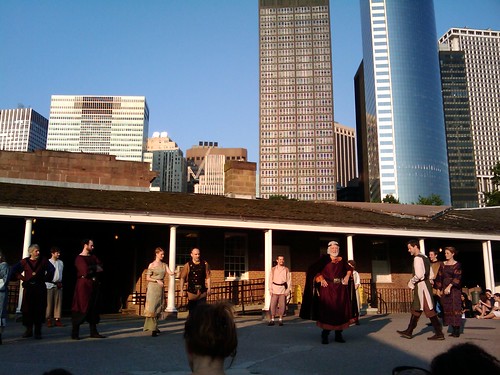
A few weeks ago I went with a bunch of friends to see a performance of King Lear. It wasn't in a theater on Broadway, though - the play was performed across the grounds of Battery Park. New York Classical Theater is "a group dedicated to reinvigorating and creating audiences for the theatre by presenting free productions of popular classics and forgotten masterpieces in non-traditional public spaces throughout New York City." King Lear was performed scene by scene in different areas of Battery Park. Each scene lasted about 5 to 10 minutes, and after one ends the entire audience is rushed behind the cast to a new environment. Backdrops such as the old fort, the river, and the forest were all included as an impressive substitute for set change. The performance itself was great, and the experience was pretty cool. We brought blankets and food, but it was a bit difficult since we were constantly moving. Also some environments were easier to view and hear, though the cast always tried hard to project their voices. Next time I see a theater in the park performance I'll read up on the story before hand so I can fill in the plot gaps when I miss a scene or two to the outdoors. Otherwise, it was a really fun night and a very interesting spin on theater. And if this sounds interesting, I also suggest checking out Shakespeare in the Parking Lot.


7.09.2009

The CrunchPad Touch Tablet Web Computer and Dreaming Big

In a few weeks Michael Arrington, leader of TechCrunch, is going to unveil his biggest project ever - the CrunchPad. The CrunchPad is a touch-sensitive tablet computer that loads directly to the web browser. It's low-powered and low on features, but completely optimized for web applications. It's designed to be the computer you keep on your couch to check fantasy sports on, to read email on, to look up IMDB on. It will have a USB drive so you can plug in a keyboard if you need, and it may end up having a web-cam for Skyping, but other than that it's likely everything you see in front of you. In a few weeks Arrington will unveil the CrunchPad at a press event and it is expected to go on sale soon after for less than $300.

Whether the CrunchPad ends up being everything we are hoping and everything we are expecting from the visionary Michael Arrington is really not the story. Arrington went from being a lawyer to a blogger to the leader of a blog & web development empire. But a year ago he decided to set his sights on something bigger; he wrote a call to arms saying he was tired of no one building the perfect and affordable web-optimized tablet. He put a call out to anyone who was interested in helping him achieve the vision, put together a team of partners, and embarked on a journey to build a piece of hardware. One year later he's days away from achieving his lofty goal, testament to his dreams, his work, his cunning, and his work ethic, regardless of his lack of prior experience. This from a lawyer-turned blogger. So despite the product that we see, or whether it succeeds, the fact that he dared to undertake it and see it through is really what's important.

Oh and if it means anything, today's Google announcement is at least a vote of confidence for his vision.

Reblog this post [with Zemanta]

7.08.2009

The Fabled Google OS Arriving Soon to Conquer Windows

Big news from the Google empire this morning! Team Google, never choosing to sit on the sidelines when they see an opportunity to make something better (see: browsers, mobile phones, TV advertising, etc, etc), has announced that they're currently building an operating system offshoot of their lightweight web app optimized browser Chrome- called Chrome OS. The operating system will essentially boot directly to a browser and run applications designed for the web. It will be open source so anyone can build off it and focus on web standards so applications that work on Chrome OS could work in any modern browser (meaning, at least today, most browsers not named - Internet Explorer). It will be clean, safe, and streamlined for optimal use on lower powered machines such as netbooks.

Google is providing no pictures right now, but they are in discussions with partners and the more information will be out soon. And around this time next year we should expect to be able to buy some Google Chrome OS powered netbooks from major manufacturers.

Whatever you think of Google and their quest for world domination, you have to give them this - when they enter a market, they go strong and they go big, and they look at how they can push the boundaries, make it better. Booting directly to a web OS isn't new (I'll write more about it later today), but Google will surely bring a polished idea to the table in a big way leveraging the clout and relationships they already have. This will likely push Microsoft hard to re-think Windows in terms of the new landscape. It remains to be seen how successful Windows 7 can be but if it's not able to maximize the effect of lower powered computer then Microsoft could lose that market by 2010.

7.02.2009

gdgt is a gadget community built by the tech obsessed for tech lovers


After months in the works, new tech community gdgt from tech legends Peter Rojas and Ryan Block launched. gdgt is a site for gadget lovers. You can create a profile, build a portfolio of gadgets that you have or had, review them, and start discussions around them. It's also designed to be the most detailed knowledge-base of gadget info and specs around - if a gadget isn't there yet, you can add it, or you can add specs to any existing product through wiki-like approach. Jump to a product page and you can see reviews, discussions, and more all in one spot; and not just from gdgt, but pulling in reviews from across populare tech sites like engadget and gizmodo (the old homes of the gdgt founders). One feature I think might be interesting on the product pages is a twitter search feed around the product; when I was trying to decide whether to buy the new Macbook Pro, I spent a while just watching the sea of twitter posts around the product for some community commentary.

gdgt as a brand has been around for a year or so, with Peter and Ryan giving a weekly podcast and running the best live blogging of big tech events (like the Apple keynotes) around. The podcasts, the live blogging, and some editorial will be continuing, and they promise many more features added as they role out their vision for the world's greatest gadget community site around.

Above is what my portfolio looks like right now - more gadgets will be added as the pages I submitted are approved (my Dell 20.1'' monitor, and my canon SD700 IS camera). Once you join, friend me here: http://user.gdgt.com/kskobac/


Reblog this post [with Zemanta]

6.23.2009

The High Line Curse (the Ghost of the High Line)


This weekend Angela and I made it over to the High Line park - a brand new park built on the old high line tracks high above the ground. The park runs right now from Gansevoort Street & Washington to 20th street & 10th Avenue, but it will eventually run all of the way up to the end of the tracks on 34th Street. The history of the park is pretty cool:
The High Line was built in the 1930s, as part of a massive public-private infrastructure project called the West Side Improvement. It lifted freight traffic 30 feet in the air, removing dangerous trains from the streets of Manhattan's largest industrial district. No trains have run on the High Line since 1980. Friends of the High Line, a community-based non-profit group, formed in 1999 when the historic structure was under threat of demolition. Friends of the High Line works in partnership with the City of New York to preserve and maintain the structure as an elevated public park.
Even on a rainy day the High Line was filled, and like everyone else I'm pretty excited about it. People were lounging in the chairs built right out of the rails and the overlook that hangs right out over 10th avenue. The view out onto Hudson River is nice as well.

BUT, we may never get to enjoy the park without grey clouds and rain, because it turns out the High Line is cursed. According to Train Jotting blog, the ghost of the West Side Cowboy, who himself died falling from the Train tracks in 1934, came to visit the pioneers of the High Line 2 years ago in a dream threatening that "he’d make it rain every day if the place of his death was trampled upon by the masses." Pretty much every day since the park has opened there has been rain, and the forecast for as far as the weather forecast goes says there will be rain as well. As long as people are happily climbing their way up to the park in the sky, will we ever have sunny skies?

(by the way, how much more am I impressed with the legendary West Side Cowboy from the 1930's than I am of the Naked Cowboy that romes Times Square today?)

Reblog this post [with Zemanta]

6.12.2009

Where are you Living and Learning Online?


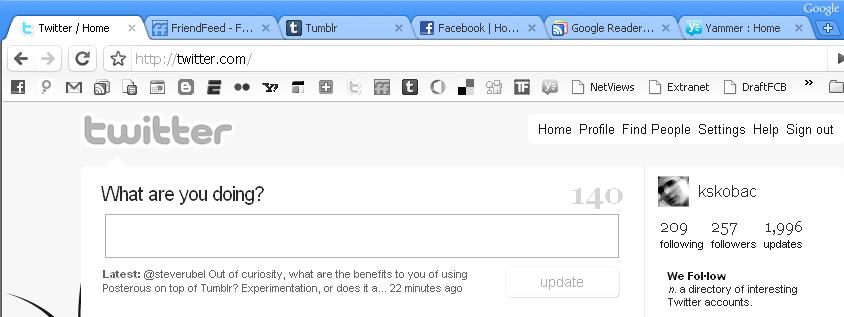
Lately I've been somewhat overwhelmed with how many place there are to consume content now online. On a given day I make my way to Google Reader, Twitter, Friendfeed, Tumblr, Facebook, and Yammer all just to read content. Some of it is news, some of it is editorial, some of it is friend content (pictures, videos, etc), some of it is recommended links, etc. And, yeah, there is a lot of overlapping content in all of those places, but there is also a great deal that is unique to the environment. There are hyper-users (I'm one) who post content everywhere, and I'll probably be reading their stuff several times on each stop, but a lot of people have their spot and they stick to it. Also, more interestingly, each place has its own culture and voice. Jump over to Tumblr, for example, and it's mostly people sharing interesting pictures and music a few times a day. Friendfeed, on the other hand, is all about comments and conversation.

I usually find something great in each community that I wouldn't have found anywhere else every time I visit, so I can't stop.

The other half of it is also interesting. I syndicate my blog, my Google Reader items, and my Flickr photos all over the place, and I share some links in each of these communities. But for my specific group of friends, most of the time when I share content the only place I see a reaction/response (comments) is on Facebook. On the other hand, most articles I write here or at UsableClicks receive a majority of their traffic leads from Twitter.

So where are you spending time, where are you getting your information, where are you experiencing true community?
Reblog this post [with Zemanta]

5.08.2009

The NYC 5 Boro Bike Tour and the Leatherman's Loop


Over the last few months I've been training for two events: The Leatherman's Loop Trail Run, and the NYC 5 Boro Bike Tour.  Both of them were goals for me.  First up was the Leatherman, a 10K terrain race through rivers, woods, and hillside.  Angela and I pushed through the whole race together, on a rough 90 degree April morning.  The course was awesome, and the community of runners around the yearly event was cool to be a part of.  I wish I'd gotten pictures of the race and us, but I was worried about carrying a camera.  We ended the run covered in mud and dirt, and had to throw out our shoes, but it was definitely worth it.

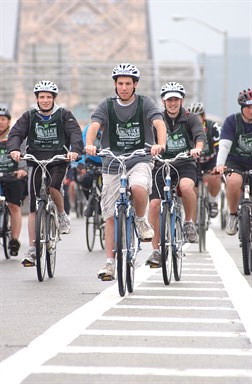
Just one week after knocking down the 10K came the 5 Boro Bike Tour.  The ride would end up being around 44 miles through the streets of New York hitting all 5 boros including an intense ride up the Verrazano Bridge before ending in Staten Island. The day is awesome because streets, highways, and bridges are all shut down for bikers for the day, and you get to see a ton of the city. Every 8 miles or so there are rest stops with food and water provided by the sponsors, and there's a celebration at the end.  However, by the time we (I road with 6 friends) were in the final third of the race, there was a serious downpour, and it was a pretty misserable ending riding wet and cold.  Still, it was much farther than I'd ever ridden at once, and it was a great experience.  Luckily there were tons of photographers along the way, and my friend Benn brought a camera, so there is much more documentation of the day.

I plan on doing both of these events next year - it was a great time, and I'm pumped that I was able to accomplish them both in a week.


5.04.2009

Google Profiles Suck, But You Need One Anyway


Google Profiles have been around for a while, but they never seemed to matter. Think of them as a fairly uninspiring social network profile: they're filled with links to your other social web presences, a single picture feed, an 'about me', and a map of where you live. The profiles are linked to in Google Reader, Google My Maps, and a few other places, but they do a poor job all together of tying together your Google presence.  Why after a year and a half in development do they not promote your recent Google content?  

Look at all of the huge opportunities that aren't leveraged here: They don't publish your Google Maps restaurant reviews (think Yelp), they don't publish your Google Chat status updates (think Facebook or even Twitter), they don't publish your most recent shared Google Reader articles (think Friendfeed), and they don't publish your most recent blog comments (think Disqus).  All together, it seems like Google is sitting on hundreds of things they could do well with Google Profiles to make them actually interesting, but they haven't done any of it.


However, despite all of that, Google Profiles has recently become incredibly important, for one reason - they now show up in Google Search.  Now once someone has activated their Google Profile, they can appear in a special "Profile results" one-box (pictured above) right on the first page of the Google results.  It's really the most direct way you have of influencing your Google search exposure, which in these days is increasingly necessary.  Your web profile is becoming your forward face to the world, and it's most easily accessed through search.  Virtually any time you go for an interview, the employer is probably looking you up in Google.  With Google Profiles (and I would also strongly recommend LinkedIn) you can now direct anyone who is looking for information on you to exactly what information you want them to discover.  You can make your Google Profile a very unexciting but powerful digital resume.

What should you put in your Google Profile?  What should Google do with the Profiles in general?  Will you activate yours?  What do you think of how I've decided to use mine?