Showing posts with label social networking. Show all posts

8.15.2010

Checking in to content consumption with Blippy and GetGlue

Two social networks I've been enjoying lately are Blippy and GetGlue. Both networks build community around content consumption and recommendations, but in very different ways. Through Blippy and GetGlue I share the apps I download, books I read, movies I see, shows I watch, and more. All of that sharing connects me to others who share my interest for the same content and leads me to recommendations of other content I might enjoy.

Blippy plugs into purchase points, enabling you to share everything from your credit card transactions to Netflix orders.  In effect it's very similar to the original idea behind Facebook Beacon, but completely opt in.  Even as open as I am I am uncomfortable with opting in to sharing my credit card transactions, but I do happily share my iTunes purchases and Netflix orders.  That means as soon as I download a new iPhone app, purchase a song on iTunes, or order a movie- a record is shared with my Blippy network.  I can later log on and review any of the items.  Something unique about Blippy though is people who view my profile can easily request that I review specific things, which means I don't have to waste time reviewing stuff that no one cares about.  In particular, I am having a great time sharing and learning about iPhone apps with on Blippy.

GetGlue has actually been around for a while as a browser toolbar that lets you easily share and comment on content you are viewing while you're online.  This could be anything from a wikipedia article you find interesting to an IMDB article about a movie or TV show.  This month they launched an iPhone app that enables more traditional check-ins similar to Foursquare, but rather than focusing on places they focus on the content consumption similar to the browser plug-in: movies, shows, music, and books.  Also in the tradition of Foursquare there is a gaming aspect, with badges and rewards.  Both the browser actions and mobile check-ins lead to discussion and recommendations.  So far with GetGlue the best conversation I've had has been around sharing when I'm reading The Facebook Effect.

I always recommend trying new social tools to see if they fit for you, and these two are definitely getting my attention lately.  If you do give them a try make sure to connect to me:

Blippy
GetGlue

3.18.2010

Sorry, More on Foursquare: The Business & Life Tracking Opportunities

As if I wasn't a big enough evangelist already, Foursquare's announcement of a location dashboard for businesses is further proof to me of how disruptive the location check-in game will be.

The early iteration of the location dashboard that Foursquare revealed at SXSWi lets businesses view the data around the check-in activity at their own location. Right now this is limited mostly to who & how many people are checking in at what times of each day, but you can already see the seeds being planted for a much deeper platform. Foursquare mentioned they are looking at including weather data so stores can see how their foot traffic is impacted. What if Foursquare opens up the platform so any data layers of a propper format could be brought in, similar to how Google Calendar operates? Businesses might be interested in traffic patterns or holiday calendars. They might want to import purchase volume or coupon history. They will also benefit from tracking their various location based ad offerings.

And what about companies being able to use check-in's for their loyalty cards or personal visitation records through the Foursquare dashboard or API? It sounds like Tasti-Dlite is working on this, and I'd love to see Starbucks count my check-in towards a free coffee. It also makes sense for my gym not to have to swipe me in once I check in.

The location dashboard is great for businesses, but it's also exciting to consider the different opportunities that this hints at for the Foursquare users. Right now every time I look at my check-in history on Foursquare.com I think of Mint's metrics. We have access to limited data so far, but we could be able to dive into our entire historical trends in order to see how our choices of how we spend our time have evolved over the year. And just the way I use Mint to figure out my years expenditures for insurance, I want to use Foursquare to see my years gym visits for my health insurance.

In fact what I'd really love is somehow be able to mary the data between Mint and Foursquare. Usually one reflects the other, but if I ceck in at a restaurant and don't use a credit card then It would be very cool if foursquare could somehow tell Mint to leave a placeholder for a cash transaction. Though Mint and Foursquare seem far apart in some ways, the fact that they both help me to track and analyze my life patterns makes me think the data should be merged and leveraged together.

I could go on but the point is clear. On the surface Foursquare is a social network and a game, but the data layer below it is a powerful utility for us players and the business owners we are interfacing with. Foursquare's API is already getting used, but as it becomes more robust and people start truly start innovating on top of it's platform, I look forward to seeing the possibilities.

Reblog this post [with Zemanta]

6.12.2009

Where are you Living and Learning Online?


Lately I've been somewhat overwhelmed with how many place there are to consume content now online. On a given day I make my way to Google Reader, Twitter, Friendfeed, Tumblr, Facebook, and Yammer all just to read content. Some of it is news, some of it is editorial, some of it is friend content (pictures, videos, etc), some of it is recommended links, etc. And, yeah, there is a lot of overlapping content in all of those places, but there is also a great deal that is unique to the environment. There are hyper-users (I'm one) who post content everywhere, and I'll probably be reading their stuff several times on each stop, but a lot of people have their spot and they stick to it. Also, more interestingly, each place has its own culture and voice. Jump over to Tumblr, for example, and it's mostly people sharing interesting pictures and music a few times a day. Friendfeed, on the other hand, is all about comments and conversation.

I usually find something great in each community that I wouldn't have found anywhere else every time I visit, so I can't stop.

The other half of it is also interesting. I syndicate my blog, my Google Reader items, and my Flickr photos all over the place, and I share some links in each of these communities. But for my specific group of friends, most of the time when I share content the only place I see a reaction/response (comments) is on Facebook. On the other hand, most articles I write here or at UsableClicks receive a majority of their traffic leads from Twitter.

So where are you spending time, where are you getting your information, where are you experiencing true community?
Reblog this post [with Zemanta]

5.04.2009

Google Profiles Suck, But You Need One Anyway


Google Profiles have been around for a while, but they never seemed to matter. Think of them as a fairly uninspiring social network profile: they're filled with links to your other social web presences, a single picture feed, an 'about me', and a map of where you live. The profiles are linked to in Google Reader, Google My Maps, and a few other places, but they do a poor job all together of tying together your Google presence.  Why after a year and a half in development do they not promote your recent Google content?  

Look at all of the huge opportunities that aren't leveraged here: They don't publish your Google Maps restaurant reviews (think Yelp), they don't publish your Google Chat status updates (think Facebook or even Twitter), they don't publish your most recent shared Google Reader articles (think Friendfeed), and they don't publish your most recent blog comments (think Disqus).  All together, it seems like Google is sitting on hundreds of things they could do well with Google Profiles to make them actually interesting, but they haven't done any of it.


However, despite all of that, Google Profiles has recently become incredibly important, for one reason - they now show up in Google Search.  Now once someone has activated their Google Profile, they can appear in a special "Profile results" one-box (pictured above) right on the first page of the Google results.  It's really the most direct way you have of influencing your Google search exposure, which in these days is increasingly necessary.  Your web profile is becoming your forward face to the world, and it's most easily accessed through search.  Virtually any time you go for an interview, the employer is probably looking you up in Google.  With Google Profiles (and I would also strongly recommend LinkedIn) you can now direct anyone who is looking for information on you to exactly what information you want them to discover.  You can make your Google Profile a very unexciting but powerful digital resume.

What should you put in your Google Profile?  What should Google do with the Profiles in general?  Will you activate yours?  What do you think of how I've decided to use mine?

11.10.2008

The Second Law of Social Media

I want to take a minute to reflect on Mark Zuckerberg's now infamous second law of social media

“I would expect that next year, people will share twice as much information as they share this year, and next year, they will be sharing twice as much as they did the year before”

I think for the most part this type of growth is really happening. Those of us using digg and delicious for years are now stepping it up to twitter and friendfeed. Those of us who never used any social tools are sharing links and posting status updates to facebook. Wherever you are on the growth curve, though, most of us are doubling the amount of content and information that we're sharing year over year - whether it feels like it or not. Sharing content is really the way we all socialize on the web, it's the backbone of the most basic social networking, it's what makes it addictive rather than repetitive. And it's only going to become more mainstream, more commonplace, more build into our everyday actions naturally- we might as well accept it and get used to it.

(To see an example of how much content i share on the web, look at the red mybloglog widget on the right of this site, or check out out social footprint here)

8.24.2008

Skydeck Turns Your Mobile Phone Call Data Into a Social Network

Skydeck Logo

Tonight I decided to give Skydeck a try - it's one of those social utilities you probably haven't heard of but might really enjoy using.  You connect it to your mobile phone company's website, and it scrapes your phone bills to build out a social network around your call and text information.  From here you can see who your true contacts are ranked by the amount of time you spend communicating with them.  It's on the growing list of social utilities that takes your every day behaviors and unlocks the social value, as well as http://mashable.com/wp-content/uploads/2008/06/skydeck-address-book.pngthe deeper personal utility, behind the data.  Think about how Xobni organizes your outlook info, how Last.FM leverages your music listening habits, and Mint organizes your financial data.
Skydeck has a lot of potential - it's sitting on very personal and very revealing information that speaks directly to how a majority of people do most of their communicating - their mobile phones.  However, right now it's missing many of the features that would make it great. I'd like to see more data - for example, where are trends?  I want to see minute and text usage per month, as well as per day, and per hour.  I would love to see recommendations on how to improve my phone bill, such as "most of your calls are nights and weekends, lower your day-time calling", or "you consistently go over your txt message allocation".  It needs to take a cue from Mint in terms of features.

Also, Skydeck highly touts its ability to connect with other social tools to merge with the rest of your important contact data beyond the phone number.  However, it currently really only connects with desktop tools and Plaxo, which means it's more for the business class.  The people I email with using Outlook are rarely the same people that I contact with my cell phone, so I need Skydeck to connect with Facebook, where most of my friends update a significant ammount of their contact information.  It could also potentially work well with Linkedin, just as Xobni does.

All in all, I'm looking forward to seeing how Skydeck develops - if it can add more features and create more utility, it will be a killer application.

6.12.2008

My social media map, my online footprint


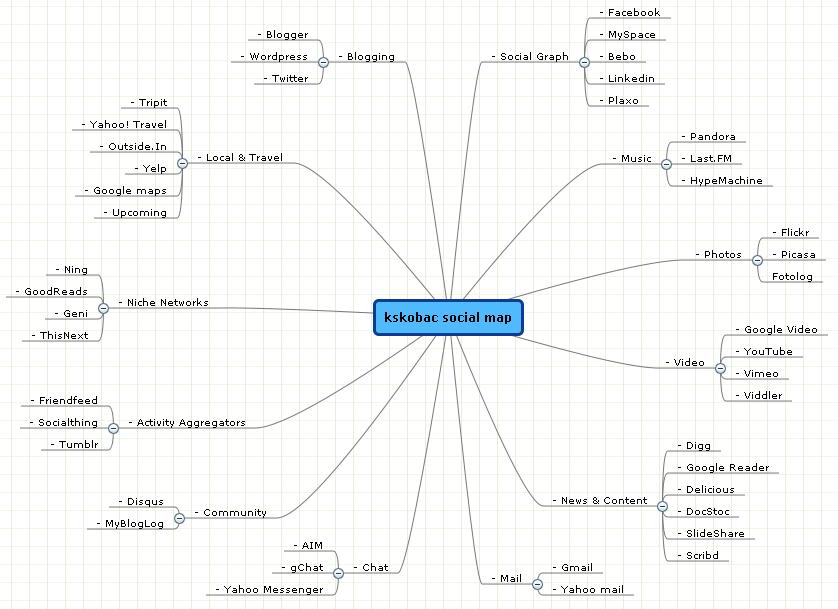
At work this week I participated in a social networking symposium. As part of the discussion, it became apparent to me just how many social tools I use to some extent or another. One one hand there is Facebook and Flickr that I use every day, Twitter and Friendfeed that I am diving into, and DocStoc and Viddler that I'm learning about. There is also GoodReads and Fotolog that I contribute to sparingly. There are "old school" social tools like IM and and eMail. The list goes on and on, as social media is slowly defining my online experience and existance. The above map is my offhand list of online social tools, drafted up in mind mapping tool MindMeister.

5.19.2008

Why aren't facebook users obsessed with Twitter yet?


Every time someone asks me about Twitter I wonder how come more people aren't interested in using it. Facebook has obviously blown up - everyone of every age is on it, and using it often, whether they claim to like it or not. People love to write on each others walls, update their statuses, and comment to each other about both. So in that case, why don't people start using twitter? Aside from the fact that through twitter you can update your Facebook status, it's essentially a combined Facebook wall and Facebook status, but through texting via a cell phone, which almost everyone I know is also obsessed with. It takes many of the things that people do on Facebook and makes them faster- your friend updates his status, and you know immediately. And if that status is "out at a particular bar" then you might find you're in the area and make your way over when it matters, not when it's too late three hours later. Your friend writes on your wall and you know immediately, and you can respond just as fast. So if Twitter in it's most basic form combines many of the things that people I know love, how come no one is using twitter?

As I'm writing this, I'm thinking - maybe it's because all we really care about on Facebook are the pictures.

12.16.2007

Google's ulterior motive of collecting more information, and Google profiles

There's an interesting interview with Marissa Mayer, Google's VP, where she discusses how Google sometimes makes moves for ulterior motives - her example being 1-800-GOOG-411.  Engineers were really looking for data to analyze in working on speech recognition modeling:

"The speech recognition experts that we have say: If you want us to build a really robust speech model, we need a lot of phonemes, which is a syllable as spoken by a particular voice with a particular intonation. So we need a lot of people talking, saying things so that we can ultimately train off of that. ... So 1-800-GOOG-411 is about that: Getting a bunch of different speech samples so that when you call up or we're trying to get the voice out of video, we can do it with high accuracy."

It's an interesting point and makes you think of Google products and Google decisions in a different light.

Seperately, Google has started integrating social features into more of their tools, and are beginning to develop the Google profile, which will follow you across their products.  Right now you can see it in Google Shared Stuff, in Google Maps, in Google Reader, and more.  In Google Reader, you can now see your gmail and chat contacts' shared feeds in a separate dashboard.  Soon you will hopefully begin to receive information flow about more actions directly within the same contact dashboard, just like the newsfeed in facebook (these same contacts are updating shared documents, adding photos to Picasa, building maps, etc).

View and subscribe to my shared items feed here (visible on the right of this page) - and let me know if you use Google Reader.

10.21.2007

Flock is the Facebook / Flickr / Twitter / YouTube / Blogger Social Media Web Browser


Flock, the long-time in development social web browser that I wrote about 16 months ago, finally released version 1.0 of their web browser, a very different product from their beginning. Flock is meant to create a browing experience that is integrated into your social media existence - it merges you with flickr, youtube, facebook, twitter, blogger and more. The screenshot above is what Flock can look like with everything opened - your default homepage, sidebar, and top-bar.
The left bar handles your contacts in your social networks - you can sort by recent updates, or tab to a specific network. In this view you can see recent changes or postings by all of your contacts, as well as all available options for each of your contacts depending on the social network. You can also send links, pictures, and more directly to a particular friend by simply dragging an object from the main browser over to particular person in the sidebar. The top bar handles media streams - the most interesting pictures on flickr, your friends recent photos on facebook, etc. Then the main "home" tab offers you a quick view of your most recently used favorites, news updates via the built in RSS reader, and your friends recently updated media on Flickr, youtube, etc.
Additional features that are interesting - direct upload to flickr, a built in RSS reader, and a blogging tool (which this post is being written in). And the whole browser is built on Mozilla code, so most firefox extensions will be available for Flock.
I doubt many people will rush to download Flock, but I'm sure the heavy Facebook users would love it if they tried to use it. And as with all things social on the web, the more social tools that people use, the more valuable this browser will be.

Blogged with Flock

10.17.2007

The Google Social Network (Now and Future)


Today Google opened features on Google Maps that allow users to create a social profile highlighting reviews they've written, maps they've created, and a stream of updates to both. Additionally, the page includes the sidebar that was launched with Google Shared Stuff, a universal bookmarking/sharing service similar to Digg / Del.icio.us that Google unraveled last week. Currently Google Shared Stuff is a confusing product because it overlaps with Google Reader's social features, as well as Google Bookmarks, but since you can email articles, save them, publish them, and even bookmark them to other social networks (Digg for example), it's a powerful social tool. In the mean time, within one week Google has unveiled the beginning of a social network that is part Yelp, part Digg, and potentially much more diverse and powerful. Pretty soon I expect to have all of the items I share from Google products available in one place - when I add a location to my map, when I share a Google Reader item, when I upload a Picasa photo, and more. If this is integrated with Google's recently purchased Twitter Competitor Jaiku, then I will switch to Jaiku. If this all creates a universal sidebar that I can add to Blogger, then my blog will be my ultimate social publishing tool (it is slowly becoming that now, but with a great deal of work and adding of numerous widgets). And if this is all combined with Orkut, Google's popular everywhere-but-the-U.S. social network, then this the a potentially all encompassing social platform. And I'm sure all this will happen relatively soon, since the last week has pointed them in that direction, and they aren't waiting around for me to give them half-fledged ideas on this blog.

A quick shout-out - I'm writing this while sitting at Gregory's Coffee shop on Park Ave, and while I am resisting the urge to drink coffee, it smells amazing. I'll have to remember to come back!

9.16.2007

If you want to try Y!Mash, Yahoo!'s new social network


I just signed up for Y!Mash, the new Yahoo! Social network.  It has features from just about all of the other social networks, which you would expect from any entrant into the field at this point- News feeds from Facebook, modules from Bebo, etc.  I'm not really looking for another social network right now so the benefit is really how well this ties together yahoo features (and my existing blogs) easly - flickr, del.icio.us, y! music, etc.  If someone is interested in testing it out, let me know and I'll send an invite.  The site is in early stages, and nothing overwhelming, but it can't hurt to play around with.


Google is rumored to be coming out with a social stream that ties together the work you're doing on everything that Google owns - YouTube, Blogger, Google Docs, Picasa, etc.  If only Picasa was as strong as Flickr...

I'm not sure why Google or Yahoo! hasn't bought Twitter, either, and rolled that into a powerful blogging platform.  Right now I'm posting to Flickr, Twitter, Del.icio.us, and Blogger regularly, with other tools scattered in.  These are the best tools to chronicle day to day life, and Twitter still and leveraged.

By the way - I got my invite to Y!Mash from InviteShare, the web 2.0 beta invite sharing tool now owned by TechCrunch.  It took all of 30 seconds between me signing up and receiving the invite I wanted.

3.20.2007

Facebook use

So in line with my post yesterday proposing that Facebook turn itself into a more full featured start page with search and customized news feeds, today there's discussion on Hitwise about social network site growth and Comscore on repeat visitors. You'll notice that Facebook is second in market share of social networks (February 2007), but it has the top spot in several important categories: the average user goes to Facebook 9.4 days a month, uses the site 23.6 times a month, and goes 2.5 times a day (MySpace is 8.6, 18.9, and 2.2 on these stats respectively). This speaks to a more loyal or addicted audience. What would be more interesting is to see the results when they aren't skewed by the once a month user or the initial sign up user - how often does the average person visit a social network if they're a consistent user, someone who goes for a few months consecutively. Ten times a day? 200 times a month?

A bigger suprise - Bebo time spent blows all other sites out of the water - the average user spends 302.7 minutes a month on Bebo, in only 12.2 visits monthly (as apposed to Facebook, which is next highest at 199.9 minutes over the 23.6 visits monthly).


Technorati Tags:
, , , , , ,

1.28.2007

Search for songs by singing or even humming with midomi


This is pretty impressive. There's a new search engine called midomi that allows you to sing some of a song, or even just hum the tune, and it will find the song you're looking for. It then lets you hear a sample of the track, clips of other people who recorded themselves in searching for the song, and purchase the track for download. I gave it a try by singing "wonderwall" by oasis, which it found no problem. Then Ari gave it a shot by humming "buddy holly" by weezer, and even without words it was the first result the search engine came up with. Considering how bad we are at reproducing anything we hear, that speaks well for midomi.


So will it be successful? There are a lot of ways audio search could have a huge impact in the next few years. Google is rumored to be working on an audio based search tool that gives you live search results based on what it hears you listening to or talking about. There is always audio search within podcasts, but that's more transcribing the content and allowing it to be searchable via normal means. The road midomi is going down right now, song search, probably has its limitations - after all, if you know the words to a song, you can find it much more easily using Google. However, if you just have a tune stuck in your head, that's a nagging thing that we all desperately deal with every once in a while, and a solution to that is welcome. Now the question is what more they can do with it?


Another angle - it may end up being more of a karaoke style social network. Once you sign up, you can record your versions of the songs you find. It's fun to listen to audio clips of from other people and hear how the engine paired what you recorded yourself with what they had in their database. Singing yourself and testing the engine is ammusing. And the voyeurism that comes with listening to the singing attempts of others always has its place. If search technology alone isn't in midomi's future, a variety of a social network might be.