The subtlety of (don’t be) evil: considering Google's ambitions
[A blog post I wrote for Medium, but never published, after Google IO]
In the aftermath of Google’s annual IO conference that ended with an impassioned speech by Larry Page pleading with the tech industry to stop fighting and start focusing on making the world better, it’s worth revisiting Google historic Don’t Be Evil mantra. The irony was not lost on anyone when, at the same time Larry Page was preaching unity, Google lawyers were requesting that Microsoft pull their recently launched YouTube app from the Windows Phone Store.
Here is why I believe in Google, why I buy into their mission: more often than not, Google’s work helps make the world better. Whether its breaking new ground with products no one ever thought of, or entering competitive industries that already have clear leaders, its typically doing so to significantly benefit us all by starting massive leaps forward.
Oftentimes critics label Google’s ambitions in productivity (i.e., Google Docs), web utility (i.e., Chrome), Geography (i.e., Maps), and mobile (i.e., Android) as evil because they were competitive efforts in someone else’s industry. But in each case, Google helped drastically change the market for the better. Microsoft wasn’t innovating with its Office product and clearly had no vision for the era of web connectivity. Firefox had done the hard work of unseating Microsoft’s hold on the browser market, but it took Google’s entry into the industry to ignite the incredible acceleration in web browser speed, standards compatibility and cross-platform sync. Google Maps proved MapQuest was actually a laughable product that was doing a fraction of what mapping was capable of. And while Apple made the biggest contribution to the mobile industry ever by breaking the carrier stranglehold, it needed a foil in Google to expose the value of open platforms. In each instance, Google entering the market has ignited competition that has lead to greater and greater products and services for users.
For me, whether Google is acting evil or not is determined by whether it can really effectively make a difference in a market it enters, not just steal someone’s revenue.

5.17.2013
4.07.2013
Facebook Home is a beautiful, but contradictory, vision for our mobile future
The rumors of a Facebook phone have been around for years now. And with each new mobile app or functionality that Facebook launched-- Facebook Messenger, Facebook Camera, Facebook Messenger with voice calling... the noise grew louder. But the question always remained: a Facebook phone sure seems great for Facebook, but why is it great for us?
Finally on Thursday Mark Zuckerberg walked on stage and gave us our answer in the form of Facebook Home. Its not a phone, he said, its a whole new way of experiencing mobile. Its a paradigm shift from apps to people. Its the way mobile social was always supposed to be. Oh and by the way, its the best version of Facebook yet.
Well therein lies the rub. Mark Zuckerberg did unveil a beautiful vision for the future of mobile. The immersive cover feed seems like we could get lost in it for hours. Elevating chat above the app layer is a stroke of brilliance that changes the meaning of multitasking. It certainly feels right to be looking at people and actions, not apps.
But by its very nature, the Facebook phone-- or loader or whatever you want to call it-- is a contradiction. It simply turns your smartphone into one big Facebook app, suppressing almost anything but Facebook's already people-first behavior. Its a glorified app at the expense of how people really exist today-- as a multitude of experiences and behaviors across a wide variety of platforms and ecosystems.
You see, people today don't just want to communicate on Facebook. They want to stream news on Twitter, express themselves on Tumblr, explore on Foursquare and more. A Facebook phone can never really become the world's first truly people-first phone unless it embraces every way people really communicate. Facebook, on its own, cannot be a phone for the people.
Mark Zuckerberg mentioned several times on Thursday how Facebook Home wouldn't have been possible without the amazing commitment by Google to make Android open. If Zuckerberg really wants to be the champion of a people-first mobile future he should match that by building Facebook Home to embrace all of the other interactions, on Facebook or otherwise, that people want to have. THAT will be the best version of Facebook yet.
Finally on Thursday Mark Zuckerberg walked on stage and gave us our answer in the form of Facebook Home. Its not a phone, he said, its a whole new way of experiencing mobile. Its a paradigm shift from apps to people. Its the way mobile social was always supposed to be. Oh and by the way, its the best version of Facebook yet.
Well therein lies the rub. Mark Zuckerberg did unveil a beautiful vision for the future of mobile. The immersive cover feed seems like we could get lost in it for hours. Elevating chat above the app layer is a stroke of brilliance that changes the meaning of multitasking. It certainly feels right to be looking at people and actions, not apps.
But by its very nature, the Facebook phone-- or loader or whatever you want to call it-- is a contradiction. It simply turns your smartphone into one big Facebook app, suppressing almost anything but Facebook's already people-first behavior. Its a glorified app at the expense of how people really exist today-- as a multitude of experiences and behaviors across a wide variety of platforms and ecosystems.
You see, people today don't just want to communicate on Facebook. They want to stream news on Twitter, express themselves on Tumblr, explore on Foursquare and more. A Facebook phone can never really become the world's first truly people-first phone unless it embraces every way people really communicate. Facebook, on its own, cannot be a phone for the people.
Mark Zuckerberg mentioned several times on Thursday how Facebook Home wouldn't have been possible without the amazing commitment by Google to make Android open. If Zuckerberg really wants to be the champion of a people-first mobile future he should match that by building Facebook Home to embrace all of the other interactions, on Facebook or otherwise, that people want to have. THAT will be the best version of Facebook yet.

2.11.2013
Trading in my iPhone 4S for a Google Nexus 4

Ever since I fell in love with the Google Nexus 7, I've been thinking about trading in an iPhone for an Android phone. As I mentioned before, I think innovation in the mobile Operating System space is largely coming from Google (and even Microsoft) right now, and in comparison Apple's iOS is starting to feel stale. The release of Android 4.1 Jellybean this summer was a turning point for Android, but there wasn't a phone worth buying yet until Google released the Nexus 4, a flagship phone in the same lineage of Nexus 7 that would always feature the latest version of Android. As lucky would have it, I won a new Nexus 4 at a Google event, so this week I decided to take the plunge.
I popped the sim card out of my iPhone and transitioned full time to an Android phone.
I'm going to spend a lot more time with the phone before I give an official review, but until then it's worth sharing some my initial reactions for anyone about to make a similar phone change cold turkey. The phone itself is beautiful. It's slim and light, but with a big beautiful screen. Multi-tasking and cross-app integration is pretty fantastic (as It's always been on Android). Voice recognition and other typing alternatives like native swype-style keyboards make information input a breeze. The operating system is much more informative and actionable-- from better app notifications, to better data about your power usage. And I have really high hopes for Google Now.
But there's also a lot of surprises. Though the phone is very fast, the touch response feels a bit slower, akin to how Windows trackpads often feel compared to Apple. And even though the operating system itself is fantastic, many applications aren't matching it in quality. It seems many companies delay in rolling out their best features to Android, so applications I love on iPhone are only subpar on Android (for example, Evernote Hello doesn't have business card scanning functionality yet, and Nike+ doesn't have friend leaderboards or Path integration yet-- both popular features on their iOS equivalent). And some great apps are still missing all together.
Also, Android's old selling point-- the most powerful versions of Google own applications-- isn't even true anymore. The latest versions of Google Maps, Gmail and Google+ on iPhone are pretty killer, even better, I think, than what's on Android right now. I think this is because on iPhone Google has a the highly evolved standard gestures of iOS, a refined standard that doesn't yet exist on Android (things like pull to refresh, left-swype menus and click-to-top headers).
So it will be an interesting ride. I can already see a ton of pluses and minuses of both iOS and its standard hardware build (the weight and size is definitively easier to hold, but harder to read on) and the operating system (a more open OS leads to better integration but less polished functions). I'm sure I'll learn a lot more as I spend an extended period with the phone. And then come July, when the next iPhone comes out, I'll be ready to make an informed decision on what platform I'm going to commit to my next two years. In the mean time, let me know if you have any Android suggestions or questions.
2.08.2013
Our Vineviewer Vine Search Engine Gets Some Love

We launched our labor of love VineViewer (a Vine video search engine) to the public one week ago now. It's been an exciting seven days, so I wanted to provide an update on our web app.
Since roll-out, our development partner Firefall Pro has been killing it with feature updates and stability optimizations. Now each Vine video has its own "card" which includes a link to the video post's original Vine post page as well as the shared Twitter post page. You can search for multiple keywords at once, and search results now have unlimited scrolling. Videos fail much less often, but when they do, we serve a nice error graphic instead of a 404 page. There's a new "about" message that appears when you roll over the corner plus (+) graphic. And the design is a lot cleaner overall.
We've gotten some pretty awesome coverage in the press:
- A full article in FastCompany Co.Create
- Featured on AdAge: Creativity
- Bylines in Business Insider and Media Bistro: AgencySpy
- Listing in AdAge's Ad Critic Top 20
And most of all, people seem to really enjoy using it. Over 2,600 people have used the app so far, to search for everything from video game clips to peeks at the winter storm Nemo. And the average visit duration is climbing to now over 3 minutes per visit (amazing, considering Vines are 6 seconds).
I hope VineViewer grows as a part of the Vine community. We'll be thinking about ways to make it more useful. In the meantime, continue to share it, and let us know what you think.
2.01.2013
We Built a Vine Search Engine

Last week Twitter launched a new video product called Vine, which enables users to quickly & easily record and share 6 second videos. Vine's big innovation is its way of enabling people to stitch a video together without having to use any editing tools, the result of which is a drastically lowered barrier to making an interesting looping clip. I'm loving Vine because vine videos feel really raw and intimate, characteristics that are unfortunately sparse these days now that just about every photo is cropped to a square, filtered and bordered.
But as much fun as it is to watch Vine videos, there's unfortunately no way to easily search for vines of topics of interest. Enter VineViewer:
VineViewer is a fun utility developed (rapidly) by SS+K and Firefall Pro designed to allow people to search the growing library of vines based on their tags. We were really excited by the launch of Vine. Like everyone else in our business, we immediately began thinking of different ways we might bring vines in on our client work. In doing so, we lamented that there was no simple way to search for vines of a specific topic, like love for Valentines Day.
VineCreeper is in in constant beta, and may evolve as we come up with more ideas for Vine. We hope people enjoy, and use at their own discretion.We concepted and created VineViewer in just a couple of days, to fill a need and interest we had. It's certainly rough around the edges, and there are some more features we'd like to implement (like a widescreen view and endless scrolling), but we wanted to launch it immediately for all Vine lovers to enjoy. Learning about new social tools is all about using and prototyping, not polish.
So search for cats, puppies, babies and NYC to your hearts content. Let me know what you think, and share it with your friends.
1.23.2013
Blogging is set to have a new golden age

The welcome screen of Medium.com (created by Biz Stone & Ev Williams of Blogger + Twitter fame)
Today Quora announced a new blog functionality. It's not surprisingly getting a lot of attention because, on the surface, it appears to be a pivot for the company. But in reality it feels like a natural extension of Quora's platform, in support of Quora's core mission:
Quora's mission is to share and grow the world's knowledgeAnd while interesting, smart question asking has unearthed some even more amazing knowledge, without the right question a lot of great knowledge won't be published. So Quora's blogging product enables everyone with something great to say about a topic to contribute to it through a blog post. That's Quora's innovation on blogging, by the way -- adding the ability to post original insight to a topic, without having to worry about building a following.
But Quora's new blog product is just another developing in an even more exciting trend: a new golden age of blogging.
After years of stagnation in the blogging space, the last few months have seen a flurry of blogging innovation. Svbtle, Medium, Branch, and Quora have all created new publishing platforms that embrace smart, intelligent writing in unique ways. They all embrace design as a way of enhancing the writing and reading experience. And all of these platforms are helping to fight back against the trend of character counts, meme machines and animated gifs.
Branch, in particular, has me really excited because of how it's making social dialogue interesting again (more on this from me soon).
So if you've forgotten what it's like to write longer than 140 characters, or you're tired of just seeing auto-animated images, and you want to dive into some really interesting, thought-provoking content, start exploring one or two of these new platforms that are helping reignite a new golden age of blogging. And share with me what you've found.
1.21.2013
My Social Media Footprint, January 2013
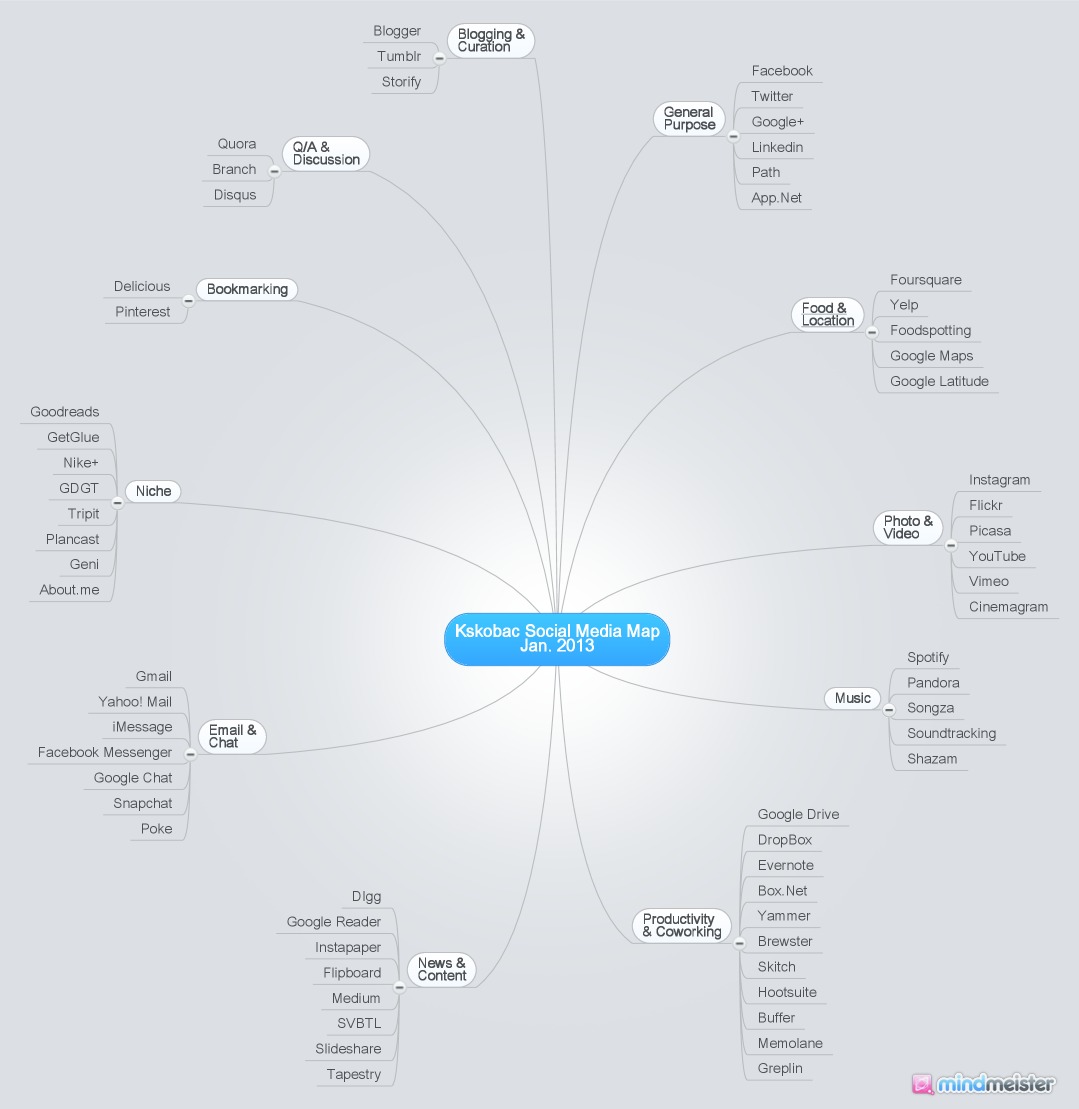
At the beginning of the year, I like to take stock of the websites, apps and technologies that I'm using on a regular basis. This time I returned to an exercise I performed four and a half years ago when I drafted a map (see below) of my social media presence. The social web has grown exponentially since 2008, so obviously there are more properties than ever on my map. But what's more interesting is some of the trends that are illustrated.
For starters, websites, apps and tech have all merged so much so that doing different lists seems a bit silly. For this exercise, I used a loose definition of listing websites & apps that revolve around social interaction, be it creation, communication, management or sharing.
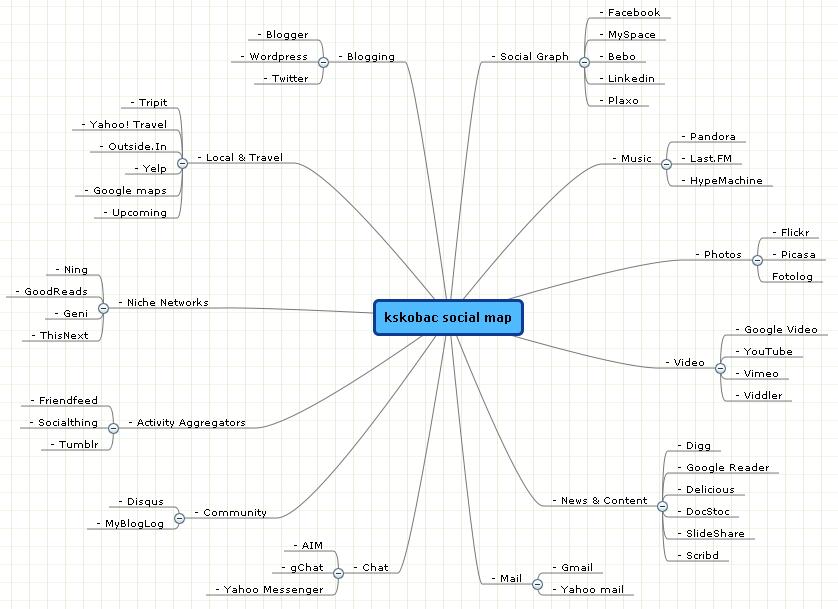
Also, many sites have changed classifications since 2008. For example, my old graph has Tumblr listed as an aggregator, but since then Tumblr has switched from a pull-type service to a creation platform. In fact, aggregators as a whole have basically gone away.
And social productivity was certainly a thing in 2008, but it was an outlier, not a tentpole category as it is now. That feels like a reflection of the evolution of corporate IT, which has largely embraced things like Google Apps, DropBox and Evernote.
It's crazy to think how many social properties I've enjoyed that weren't even around four years ago, and amazingly are already obsolete (things like Posterous). And certain categories are starting to be disrupted again, though they were relatively stagnant all this time. Blogging is one of them.
I look forward to doing this exercise many times over in the years to come. It's always interesting to sit back and take stock of how the web is evolving. For the sake of comparison, here is my map from 2008.
1.15.2013
7 Discoveries and Observations from the CES 2013 Conference Floor

1. No matter how good you think your TV is now, it can always get better.
This year television manufacturers showed off new Ultra High Def (UHD) televisions that have 4K resolution, or about four times the resolution of today's high definition screens. These big and beautiful TV's show virtually no pixelation when displaying UHD content (though upscaling non-UHD content may be less compelling). Also present were new curved televisions that enable viewers to have a more balanced viewing experience (each inch of the screen is equidistant from the viewer), and an impressive dual-view 3D TV by Samsung that enables two people to watch different high definition 3D broadcasts in full screen at the same time from the same television.
2. It's more fun to use human interfaces and have physical interaction.
While TV's, phones, computers and cameras steal the headlines at CES, smaller companies tucked away in the corners innovating in ways you can't imagine are much more fun. And many of these companies are helping us to interact with the world a bit more by building physical interaction into technology. One particular cool gadget is Sphero, a hackable robot ball that you can control via your iPhone, around a physical track. Sphero can also trigger augmented reality experiences, and be used itself to control computer programs through physical manipulation. Also peek at Sifteo cubes, small computer cubes that pass information between each other, enabling all sorts of interactive puzzles and games.
3. Health technology and the quantified self are at a tipping point.
All sorts of companies are making health-tracking devices, from health start-up fitbit, to Nike Fuel to Jawbone Up, that track anything from how many steps we've taken to how well we're sleeping. But wearable bracelets won't be the only way we measure, share and analyze our health data. Withings has a connected scale that measures your weight, BMI, heart rate and even the air quality around you. As more companies enter the health tracking fray product innovation will collide (Withings has a wearable monitor now, and Fit Bit has a connected scale). The bigger question will be how well these companies can guide our real life health improvements based on all of the data we're collecting.
4. Every device will be connected soon (so plan for bigger data plans).
Just about everyone seemed to enjoy playing with Samsung's new Galaxy Camera, an internet connected digital camera with an Android operating system built in. Now you can install your favorite mobile apps like Instagram right to your camera to filter and share photos as soon as you take them. Samsung also showed off a connected refrigerator that includes popular applications like Evernote, so people can collect recipes from anywhere and browse or view them directly on the screen in their kitchen. With the internet of things growing so quickly, ubiquitous connectivity and shared internet plans will need to improve along with it.
5. Kickstarter is one of the most exciting names in consumer technology.
One of the most anticipated announcements at CES was from Pebble, the ambitious smart watch that was funded on Kickstarter. The Pebble raised a record-setting $10 million dollars to build their product back in April, but didn't announce their shipping date until CES. If Pebble lives up to its promise once in the hands of consumers, the next CES might be much more focused on the independent technology innovators that are arising in part to innovative funding models like Kickstarter, rather than the big behemoth technology companies that lead the market today. In fact, many of those big market leading companies seem to be pulling out of CES all together.
6. The big four internet companies are confusingly second fiddle at CES.
Google, Apple, Amazon and Facebook, known as the big four internet companies, have become successful through their merging of content, services and technology in a user-friendly way. Each, to different degrees, are defining what it means to be a connected product today, from user experience to content to ecosystem compatibility. And while CES is full of other companies making devices for those platforms, the names defining the space need to stand up and illustrate their vision for the future. There may have been hundreds of devices from different companies on the CES floor that included Android, but Google needs to lead the discussion of how all these devices will work together with Android at its core.
7. Welcome to the new CES, it's not just a trade show.
The biggest story going into the week was actually how few product announcements would be taking place, with many technologies likes cameras and phones now saving their biggest own popular trade shows later int he year and big names like Microsoft having left altogether. But a reported 150,000 people from all walks of life attended the convention this year, the largest audience in CES history. More significant may have been the tens of thousands of brands, sales and marketing companies who spent the week in Las Vegas talking about the implications of the consumer electronics revolution and its implications on media and marketing, without ever stepping on the conference floor. CES may be changing, but for new reasons its just as interesting and important none-the-less.
Subscribe to:
Posts (Atom)
