1.21.2013

My Social Media Footprint, January 2013


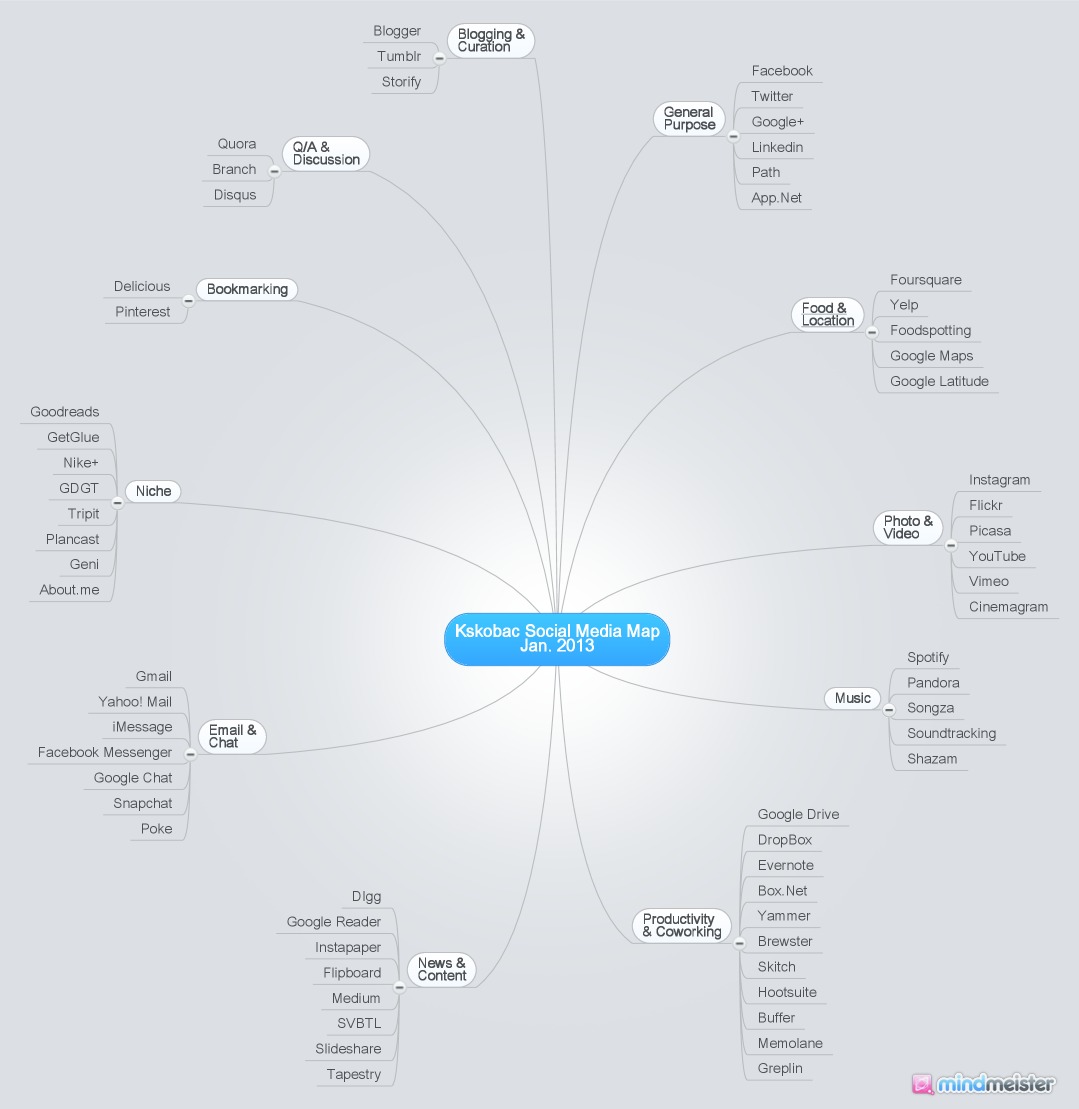
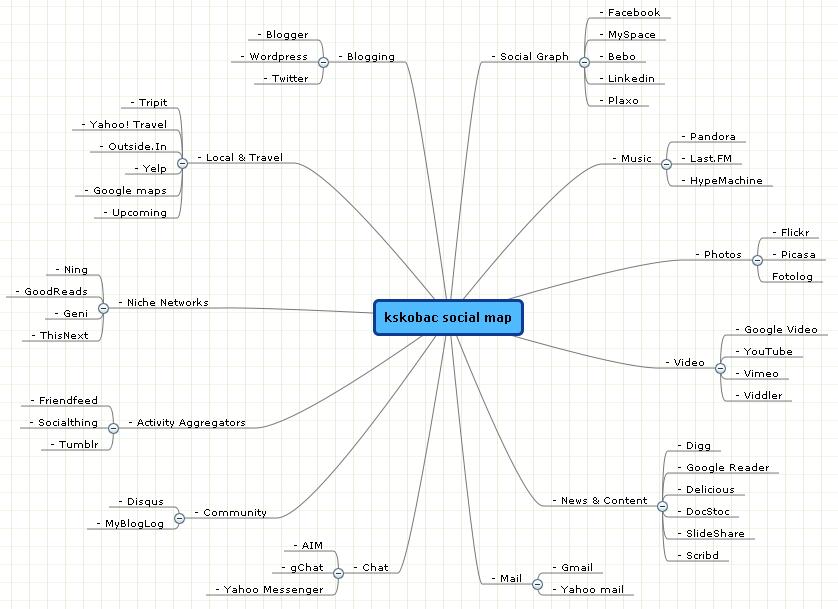
At the beginning of the year, I like to take stock of the websites, apps and technologies that I'm using on a regular basis.  This time I returned to an exercise I performed four and a half years ago when I drafted a map (see below) of my social media presence.  The social web has grown exponentially since 2008, so obviously there are more properties than ever on my map.  But what's more interesting is some of the trends that are illustrated.  

For starters, websites, apps and tech have all merged so much so that doing different lists seems a bit silly.  For this exercise, I used a loose definition of listing websites & apps that revolve around social interaction, be it creation, communication, management or sharing.

Also, many sites have changed classifications since 2008.  For example, my old graph has Tumblr listed as an aggregator, but since then Tumblr has switched from a pull-type service to a creation platform.  In fact, aggregators as a whole have basically gone away.

And social productivity was certainly a thing in 2008, but it was an outlier, not a tentpole category as it is now.  That feels like a reflection of the evolution of corporate IT, which has largely embraced things like Google Apps, DropBox and Evernote.

It's crazy to think how many social properties I've enjoyed that weren't even around four years ago, and amazingly are already obsolete (things like Posterous).  And certain categories are starting to be disrupted again, though they were relatively stagnant all this time.  Blogging is one of them.

I look forward to doing this exercise many times over in the years to come.  It's always interesting to sit back and take stock of how the web is evolving.  For the sake of comparison, here is my map from 2008.


1.15.2013

7 Discoveries and Observations from the CES 2013 Conference Floor


1. No matter how good you think your TV is now, it can always get better.
This year television manufacturers showed off new Ultra High Def (UHD) televisions that have 4K resolution, or about four times the resolution of today's high definition screens.  These big and beautiful TV's show virtually no pixelation when displaying UHD content (though upscaling non-UHD content may be less compelling).  Also present were new curved televisions that enable viewers to have a more balanced viewing experience (each inch of the screen is equidistant from the viewer), and an impressive dual-view 3D TV by Samsung that enables two people to watch different high definition 3D broadcasts in full screen at the same time from the same television.

2. It's more fun to use human interfaces and have physical interaction.
While TV's, phones, computers and cameras steal the headlines at CES, smaller companies tucked away in the corners innovating in ways you can't imagine are much more fun.  And many of these companies are helping us to interact with the world a bit more by building physical interaction into technology.  One particular cool gadget is Sphero, a hackable robot ball that you can control via your iPhone, around a physical track.  Sphero can also trigger augmented reality experiences, and be used itself to control computer programs through physical manipulation.  Also peek at Sifteo cubes, small computer cubes that pass information between each other, enabling all sorts of interactive puzzles and games.

3. Health technology and the quantified self are at a tipping point.
All sorts of companies are making health-tracking devices, from health start-up fitbit, to Nike Fuel to Jawbone Up, that track anything from how many steps we've taken to how well we're sleeping.  But wearable bracelets won't be the only way we measure, share and analyze our health data.  Withings has a connected scale that measures your weight, BMI, heart rate and even the air quality around you.  As more companies enter the health tracking fray product innovation will collide (Withings has a wearable monitor now, and Fit Bit has a connected scale).  The bigger question will be how well these companies can guide our real life health improvements based on all of the data we're collecting.  

4. Every device will be connected soon (so plan for bigger data plans).
Just about everyone seemed to enjoy playing with Samsung's new Galaxy Camera, an internet connected digital camera with an Android operating system built in.  Now you can install your favorite mobile apps like Instagram right to your camera to filter and share photos as soon as you take them.  Samsung also showed off a connected refrigerator that includes popular applications like Evernote, so people can collect recipes from anywhere and browse or view them directly on the screen in their kitchen.  With the internet of things growing so quickly, ubiquitous connectivity and shared internet plans will need to improve along with it.

5. Kickstarter is one of the most exciting names in consumer technology.
One of the most anticipated announcements at CES was from Pebble, the ambitious smart watch that was funded on Kickstarter.  The Pebble raised a record-setting $10 million dollars to build their product back in April, but didn't announce their shipping date until CES.  If Pebble lives up to its promise once in the hands of consumers, the next CES might be much more focused on the independent technology innovators that are arising in part to innovative funding models like Kickstarter, rather than the big behemoth technology companies that lead the market today.  In fact, many of those big market leading companies seem to be pulling out of CES all together.

6. The big four internet companies are confusingly second fiddle at CES.
Google, Apple, Amazon and Facebook, known as the big four internet companies, have become successful through their merging of content, services and technology in a user-friendly way.  Each, to different degrees, are defining what it means to be a connected product today, from user experience to content to ecosystem compatibility.  And while CES is full of other companies making devices for those platforms, the names defining the space need to stand up and illustrate their vision for the future.  There may have been hundreds of devices from different companies on the CES floor that included Android, but Google needs to lead the discussion of how all these devices will work together with Android at its core.

7.  Welcome to the new CES, it's not just a trade show.
The biggest story going into the week was actually how few product announcements would be taking place, with many technologies likes cameras and phones now saving their biggest own popular trade shows later int he year and big names like Microsoft having left altogether.  But a reported 150,000 people from all walks of life attended the convention this year, the largest audience in CES history.  More significant may have been the tens of thousands of brands, sales and marketing companies who spent the week in Las Vegas talking about the implications of the consumer electronics revolution and its implications on media and marketing, without ever stepping on the conference floor.  CES may be changing, but for new reasons its just as interesting and important none-the-less.

12.21.2012

Instagram, Please let us pay! [My Digiday Article]


I'm published on Digiday today discussing Instagram's latest woes, and how consumers will increasingly demand the option to pay for things again in exchange for more rights over our privacy and content.  This is a topic I've written often about here and in social media.  We're just now starting to see the ramifications of the "free" ad-supported economy.  Twitter's API follies, Facebook and Instagram's privacy issues, and the endless folding of well-liked companies that can't make money-- this is all just the beginning.  We as consumers need to start re-considering what we really want for free, and what we want to pay for.

The article also links to SS+K's work for President Obama's 2012 re-election campaign.  You can read about how we tapped Instagram and other social channels to spread the For All message and drive the critical youth vote. 

12.18.2012

The Magic of Google Now and Thinking Different

"To me the great irony is that Apple’s slogan was `Think Different,’ but today if you think different you’re looking at Android.” - Guy Kawasaki, former Apple Chief Evangelist

As anyone close to me knows, in 2009 I made a complete jump over to Apple products.  I traded in my home PC for a 13" Macbook Pro, my work ThinkPad laptop for a (now) 15" Retina Macbook, my Microsoft Zune and Google Android HTC G1 for an iPhone.  In every instance I was happier, inspired even by the differences.  My laptops were reliable for the first time ever - they didn't suffer from memory lag, battery drain, or buggy trackpads.  The G1, which was the first Android phone on the market, had been ground-breaking compared to my feature phone before it, but the iPhone put it to pasture with its sheer speed and app quality.  I became, like most people in the Apple camp, transfixed with Apple being the height of quality and innovation.

But in the last year, things have begun to change.  I spent a few months with a Windows Mobile phone enjoying the fresh take on a mobile OS, and in the last few months I've fallen in love with my favorite new gadget, the Google Nexus 7.  The Nexus, and more specifically the new version of Android, is a revelation.  Where all six of the previous Android devices I used before fell short, the Nexus shines.  Navigating the device is smooth and intuitive, with true cross-app integration and action-oriented notifications illustrating the faults of Apple's silo'd approach.   Widgets on the lock screen and "desktop" make carrying around the tablet more useful at a glance than the iPad.  Small touches like built-in "swype" typing make the tablet typing faster.

The biggest eye-opener of all is Google Now.  At a basic level, Google Now is Google's take on Siri, but in practice it makes Siri look like a child.  Google Now taps all of Google's intelligence and all of a user's personal information to actively help you throughout the day.  Pull it up in the morning and Google Now will tell you your favorite team's sports score from last night, today's expected weather, have directions to your next appointment and how long it will take.  Open it after a flight and Google Now will tell you how long it will take you to get to your hotel, some restaurants and sites nearby you'd want to try.  The information is actively pushed to you based on what you signal to Google you need, from recent searches, email receipts, location history and more.  It's smart, surprising and useful-- in short, magical.  It shows you what's possible by tapping geo-awareness, personal information and crowdsourced intelligence at scale.  It makes you forget about all of the privacy and personal information concerns, and maybe even wish you had more to give. 

Recently I was speaking with some team members who are incredibly experienced and often "in the know".  They had not heard of Google Now, were not familiar with it's capabilities.  They carry Macbook Airs, iPads and iPhones, and presumed, as most of us do, that the best of what's possible is happening on one of those devices.  But my re-awakening to the world outside Apple emphasizes why it's so critical to step outside your comfort zone and use different products once in a while.  Why you should stop by a Windows 8 Store to explore the new Surface and HTC 8x.  Why you need to try a Nexus 7 before you commit to buying the iPad mini.  If you don't, you won't realize the possibilities that are out there, the break-throughs that are happening, the innovation that is being displayed outside of Apple's garden.  You won't realize that iOS is starting to feel really stale, sitting back passively and waiting for you to ask it a question or jump into a single app experience, while Google Now actively pushes you everything you need and more.  You won't "think different", the way Apple challenged us to.

11.12.2012

Why I Bought Tweetbot, and the Rising Cost of Apps


I just happily purchased the new Tweetbot for Mac client for $20, which is probably way more than anyone ever imagined spending on such a specific thing as a Twitter client.  But it was completely worth it to me for a few of reasons:
  • Tweetbot's developers Tapbots do incredible work for the iPhone, iPad and iOS, and I want them to keep doing it.  So I need to help them make enough money to stay in business
  • Tweetbot is not only the best desktop and mobile Twitter client available, it's probably the last great Twitter client that will ever be built because of Twitter's new horrendous API rules
  • I want to help push app paid app economy, which is suffering at the hands of downward price app store price pressure and unreasonable expectations, as proven by the Sparrow dilema
The reality is, as we move in the direction of $0.99 everything, or worse yet propagate the expectation that everything can be gotten for free, we force apps to be gimmicky, ad-laden, or catered to the lowest common denominator in the pursuit of hundreds of millions of users.  As app developer David Barnard puts it:
Computer users used to spend hundreds of dollars for great software and pay again every couple years for upgrades. But over the past couple decades people have grown accustomed to getting more and more value from software while paying less and less for it. The web has played a huge part in that, but the trend was accelerated by the App Store and Apple’s management of it.
Extremely high quality apps that appeal to a niche crowd have a harder and harder time surviving.  That will be the case until we return to being willing to reward high quality applications with adequate payment.  Unless we're happy in a world where Google and other behemoths acquire everything interesting under the sun and decide each fate as it ladders up to their larger objectives.

So I'm following up my purchase of Tweetbot by purchasing Clear, another innovative app that I want to see pursue it's goal.  And I hope others follow suit, because I'd like these products to have a chance at sticking around, and not just until Google buys them and shuts them down.

10.31.2012

NYC Taps Twitter to Power Through Sandy's Aftermath

In the wake of the craziness that was Hurricane Sandy, I'm really impressed with how Mayor Bloomberg has used Twitter to keep New Yorkers as up to date as possible on what's going with the city.

I've been following real-time updates all week via @NYCMayorsOffice, @MikeBloomberg, @MTAInsider and @NYCGov accounts.

Then this morning I noticed promoted tweets (which Twitter is providing for free to emergency services accounts) appearing in my Twitter stream highlighting the most recent city update tweets from the @NYCMayorsOffice.

And just now we were all invited to watch a live stream of Mayor Bloomberg's upcoming press conference via an embedded inline YouTube feed (see the screenshot above or the embedded tweet below).

Thanks Mayor Bloomberg, and your whole staff, for doing what you can to keep us informed!

8.17.2012

POV on Twitter's API Announcement


Below is a draft of a POV on Twitter's API changes that I wrote as part of my work for SS+K.  It's being published here post-dated as reference.

The big news in the tech industry this week was Twitter's long-expected announcement of changes to their API (the tools 3rd party applications use to plug-in to Twitter).  Twitter announced that the company would no longer support carte-blanch use of their API by 3rd parties.  Instead,Twitter is enforcing everything from design guidelines to build principles.  Their stated purpose is to focus any regular Twitter user engagement (think: the usual things consumers do on Twitter, e.g., read, reply, retweet messages) all happening on official Twitter 1st party applications.  Their demand (disguised as a request) is that 3rd parties focus on building applications that provide an inherently different functionality, especially enterprise-oriented capabilities, such as measurement and media integration.  

While Twitter is clearly within their rights to place rules on 3rd parties who want to integrate with their product, the move is being seen as incredibly controversial because Twitter's success as a platform was largely a result of the types of 3rd party developed innovations that Twitteris planning on forcing out or shutting down.  In fact, Twitter Search, Twitter for iPhone, Twitter for Android, Twitter eMail summaries and Twitterfor Chrome are all functionalities built by 3rd party companies and purchased by Twitter.  In many cases, theses applications were built to give users experience that they wanted or needed, but Twitter didn't have the bandwidth to provide.  In many ways, 3rd parties carried Twitterthrough the dark period where Twitter was often broken and unreliable.  By restricting 3rd parties, Twitter is not only turning its back on the community that helped build it, but also potentially stifling the type of future innovation that could take the platform to new heights.

Twitter's argument for these decisions is mainly two-fold:

  1. Consumers need to have a consistent experience and reliable expectations when engaging with tweets.  The company believesTwitter content needs to be uniformly designed and packaged with all of its functionality so users everywhere recognize the content asTwitter and know exactly how they can interact with it (i.e., always be able to reply or retweet).
  2. Twitter needs to be capable of earning enough revenue to support itself, and the way to do that is to make sure users are spending their regular tweeting and reading time on a standard Twitter platform that Twitter itself can monetize, through their standard promoted tweets, trends and search products.
Ultimately these changes complete Twitter's transition from communication company to media company.  Like Google with its move towards universal search and rich media snippets, Twitter is bringing more content inline into its feed through their new "Twitter Cards" format, trying to maximize the time-spent and eyeballs on its own domain.  It may not be the vision Twitter's original power users and developer community envisioned for the company, but it's clearly the direction it feels is necessary for its optimal future.  The outcome will be a more refined and uniform experience that helps Twitter grow its mainstream audience, but loses some of its advocates and puts it more directly in competition with news and entertainment media companies than ever before.

While much of the outcome of the new API rules remains to be seen, expect a few implications for brands as we head into 2013:

  • Custom brand products that pull in and display tweets, including Facebook tab applications or website plug-ins, will need to be updated to fit the new display guidelines.  This reduces the ability to customize the look and feel, but will likely increase user engagement.
  • Since Twitter Cards (inline content previews) will start to be featured abundantly across the Twitter ecosystem, brands will want to include links to supported 3rd party content in their tweets to maximize engagement potential.
  • Since the future of existing 3rd party reading clients is up in the air, companies like Flipboard will likely start to iterate in directions away from Twitter content.  Brands need to consider where they invest in media and partnership dollars if they are investing in any of these environments.
We will be watching the Twitter ecosystem + platform developments carefully, and provide further guidance on the implications, directions and opportunities as they become clear.  Please let us know if you have any questions.

6.08.2012

Rediscovering the Joy of Social Media With Path


Sometimes you don't realize you ever had a problem until you have the solution.  For a while now, without thinking about it much, most of my social networking has practically been the same experience as building a resume.  Every post on Facebook, Twitter or Flickr was curated knowing that, besides my friends, hundreds of co-workers, clients, perspective employers and more would potentially be viewing.  When Klout launched, it was the ultimate manifestation of the symptom I didn't know I had: living in public had driven me to focus too much on the necessity of perception.

Then a few months ago, enter Path. A social network that defies everything that defines every other social network.  Want people to see your content?  Too bad, it's only on your phone so there's no place for most people to view it.  Want to post a link you think will make you look smart?  Too bad, you can only share original content.  Want hundreds of friends + followers?  Too bad, you can only have 150 (which is based on Dunbar's law of the number of real relationships you can mentally manage).

What you can do? Share the song you're listening to at that exact moment on your iPod, or the location of where you're standing, or the thought you just had, or the moment you're about to go to bed.  Stuff that only a few people care about.  Stuff that you have to create with your phone, the most intimate application you have, by yourself.  Stuff that no one will see.  And did I mention Path was created by one of the first Facebook employees, after he helped build what is now the most public platform on the planet?

But Path, a mobile only social network defined as much by its limitations as its capability, is an absolute pleasure to use.  It's the  antidote to the sickness of public sharing.  It's designed with precise care to enforce an intimate experience between you and the people you care about.  It strips away the fear of something not being smart enough for the pleasure of knowing that you shared a moment with the people that matter.  It provides a freedom from the public I'd forgotten I wanted, and as such has become the social network I want to use more than any other every single day.

In exchange for the ability to make you famous, Path focuses on making you happy (in fact, their internal motto is something like "design happiness").  When you share something on Path you see the faces of every friend who looks at it, giving you instant viseral feedback.  It's easy for people to smile, frown, heart or gasp at your content.  Everything is plotted on a timeline of your day, giving you a journalistic feeling.  If you connect Nike+ to Path and share your work-outs, when someone smiles at your run on Path, you hear cheers in your headphones like your friends are there with you.

With Path, I no longer worry about credibility because there's no way to earn it.  Instead, I focus on sharing personal moments, and the reward is a closer relationship with the people I'm connected to.  It feels a lot like what social networking was probably originally meant to be.  And it's really enjoyable again, in a way much of my experience with Twitter and Facebook isn't.  Thanks Dave Morin, for learning to build great things at Facebook and then turning around and building exactly the opposite but better.